These coconut macaroons are made without condensed milk and taste better than any macaroons I've ever bought.
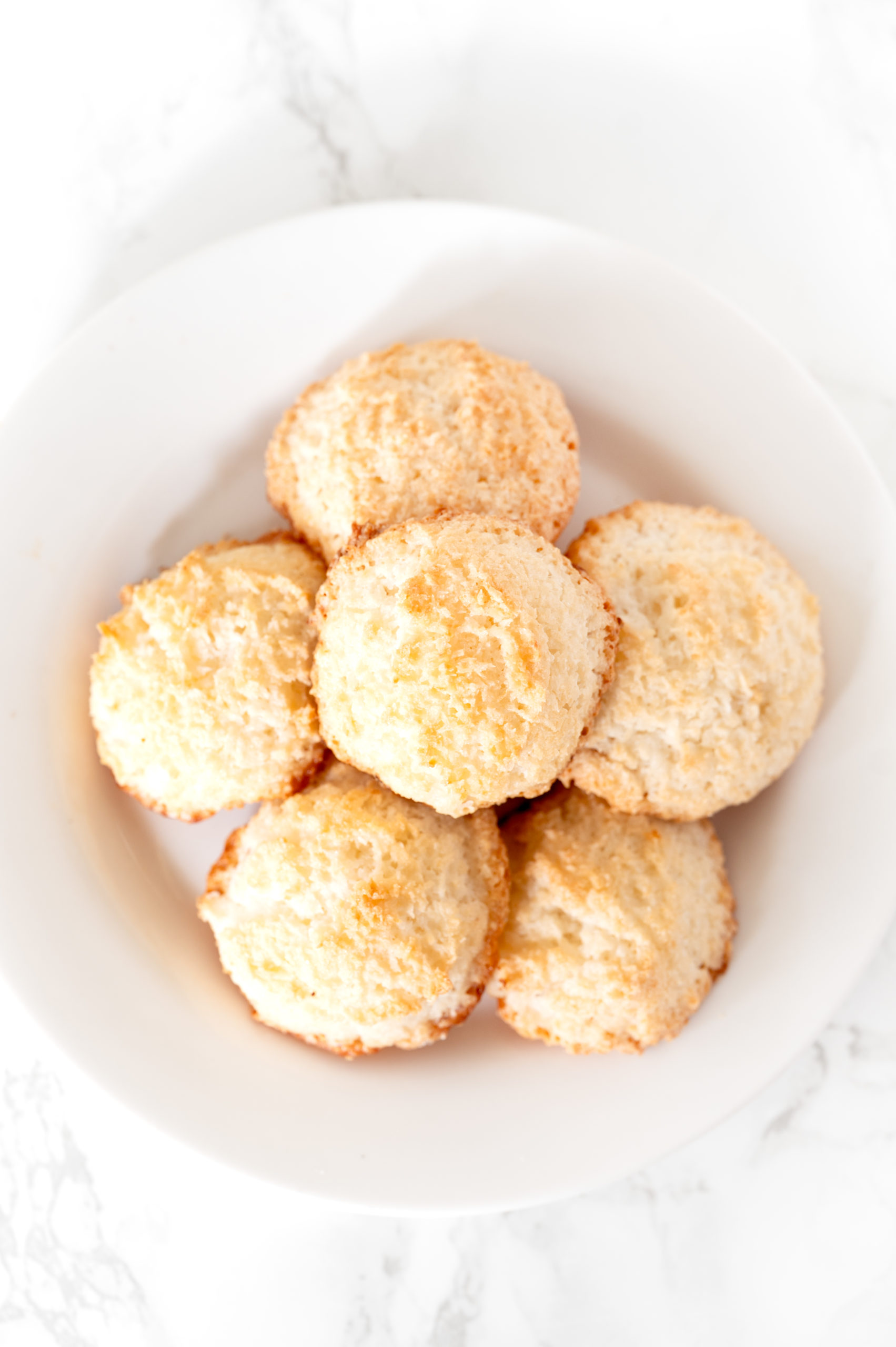
You could also make them look beautiful by dipping the bottoms and drizzling the tops in chocolate.
Don't be intimidated by using egg whites. This recipe is actually super easy to make and can even be made with kids.
If you like these Coconut Macaroons without Condensed Milk, you may also like my pumpkin pie without condensed milk and my fudge without condensed milk.
History of Macaroons
Macaroons have been traced to a French monastery of the 8th century in the city of Cormery.
Recipes for macaroons began appearing in recipe books at least as early as 1725, and call for egg whites and almond paste.
Over time, coconut was added to the ground almonds and, eventually coconut macaroons became their own thing.
In French, coconut macaroons are called rocher au coco which means coconut rocks.
Macaroons became a popular passover treat because they do not call for flour and in America they come in a variety of flavors including chocolate, chocolate chip, vanilla, and almond.
Where in America passover macaroons are typically sold in cans with bite sized macaroons, in Israel, it is very common to find very large ones in bakeries.
In Israel they are typically vanilla flavored and dipped and drizzled in chocolate.
How to Measure Flour and Other Dry Ingredients
The best way to measure dry ingredients is with a scale, but in the United States, dry measuring cups are usually used instead.
Weighing ingredients is useful for home bakers, but it's especially important for professional bakers because they work with huge batches.
I usually use dry measuring cups when baking too, because I didn't grow up in a country that generally weighs ingredients, so please don't feel like you can't use them.
To measure most dry ingredients, first spoon them into a dry measuring cup and then level off the measuring cup with an upside-down butter knife.
Make sure not to pack it down because this will cause you to use more of the ingredient than the recipe calls for.
Brown sugar is the exception to the rule, though. To measure brown sugar, pack it into the measuring cup and then level off any excess.
To measure chocolate chips, nuts, or dried fruit, just pour them into the dry measuring cup and then level them off.
What are dry measuring cups?
Dry measuring cups are the set of cups that usually come with measuring spoons. Each cup is a different measurement, just like each spoon is a different measurement.
Liquid measuring cups, on the other hand, are the cups that usually hold more than one cup and have lines on the side that mark the measurements.
The problem with using liquid measuring cups to measure powdery dry ingredients, like flour and cocoa, is that you shake the cup to level them off. This causes the powder to settle, and you end up with more than you need.
I tested this with a friend who didn't believe me, and we ended up with a quarter cup more flour than the recipe called for.
Should I sift the flour and other dry ingredients?
It's usually recommended to sift your powdery ingredients, like flour and cocoa, before using them.
Sifting aerates the flour and removes any lumps, which helps make baked goods fluffier.
It also helps you get a more accurate measurement than when you use flour that's been packed tightly in a bag.
And sifting dry ingredients together, like flour, cocoa, and baking powder, helps make sure they're evenly distributed in the batter. Which honestly, I think is probably overrated, so I personally never bother with it.
Sugar
The primary role of sugar is to be a sweetener. However, sugar also contributes to the tenderness and moistness of the baked good by absorbing and retaining moisture and helps create the golden brown color when baking as it caramelizes.
Recipes with more sugar often result in softer, moister textures. However, I learned the hard way that too much sugar leads to a sticky mess.
When it's heated, sugar caramelizes, resulting in a rich, complex flavor and a brown color. This adds both flavor and color to baked goods and is also the process in which caramel sauce, dulce de leche, caramel candies, and regular candies are made.
When used in recipes containing yeast, the sugar is eaten by the yeast, producing carbon dioxide and causing the dough to rise.
Sugar also acts as a preservative in jams, jellies, and fruit preserves by reducing water activity and preventing microbial growth.
There are many different types of sugar, including white sugar, brown sugar, vanilla sugar, powdered sugar, turbinado sugar, and demerara sugar.
When a recipe calls for "sugar" without specifying anything else, it's referring to regular white sugar.
White Sugar
White sugar (sometimes called granulated sugar, table sugar, or white granulated sugar) is made of either beet sugar or cane sugar, which has undergone a refining process.
It is the easiest to find and most commonly used.
Brown Sugar
Brown sugar is white sugar with molasses added to it.
It is commonly used in chocolate chip cookie recipes, and it's rare for a recipe that calls for brown sugar not to also call for white sugar as well.
When a recipe calls for "brown sugar" but doesn't specify what type (light or dark), it is referring to light brown sugar.
In my recipes, you can use whatever type of brown sugar you have on hand, whether it is dark brown sugar, light brown sugar, or demerara sugar - which is very common in Israel.
Just keep in mind that the flavor and color will be slightly different, depending on what you choose to use.
Turbinado Sugar
Turbinado sugar is better known as "raw sugar." But, despite this name, the sugar is not really "raw."
Instead, it's partially refined sugar that retains some of the original molasses.
The term "raw sugar" may also give off the impression that it is somehow healthier.
In reality, turbinado sugar is nutritionally similar to white sugar.
Demerara Sugar
Demerara sugar is very popular in Israel and is especially delicious in tea, but is also used for baking.
Unlike white sugar, demerara sugar undergoes minimal processing and retains some vitamins and minerals.
However, it is still not much healthier than white sugar.
Vanilla Sugar
Vanilla sugar is not very common in the States. However, it is common in Israel and parts of Europe.
This is sugar that sat for an extended period of time with vanilla beans, giving it a vanilla flavor.
Caster Sugar
This type of sugar is common in the United Kingdom.
It has a grain finer than white (granulated) sugar and larger than powdered sugar.
Caster sugar is often called for in recipes for delicate baked goods like meringues, souffles, and sponge cakes.
You can use a 1:1 conversion rate between caster sugar and white (granulated) sugar.
Powdered sugar
Powdered sugar, sometimes known as confectioners' sugar, is a sugar with a powdered texture.
This sugar is rarely used for baking. Instead, it is used for dusting desserts and making frosting, icing, and glazes.
In some countries, you can also find powdered vanilla sugar.
It is made the exact same way regular vanilla sugar is made. However, the sugar used is powdered instead of granulated.
What Kind of Vanilla Should I Use?
There are several types of vanilla you can use in baking, including vanilla extract, imitation vanilla, vanilla paste, and vanilla beans.
For everyday baked goods like muffins, cakes, cookies, and quick breads, some options are more practical than others.
Vanilla Extract
Vanilla extract is made by soaking vanilla beans in alcohol, which extracts the compounds responsible for their flavor. It is the most common type of vanilla used in baking.
When a recipe-including mine-calls for vanilla extract or simply says "vanilla," this is the type of vanilla that is generally being referred to.
Can I use imitation vanilla?
Imitation vanilla, also called artificial vanilla or vanilla essence, is considerably less expensive than pure vanilla extract and works well in everyday baked goods.
Since vanilla extract can be expensive, you can use imitation vanilla in my recipes without a problem.
Imitation vanilla can be used spoon for spoon in place of pure vanilla extract.
Though, keep in mind that some imitation vanillas are better than others, so if you can, try to use a good one.
Can I use vanilla paste?
Vanilla paste is a thick mixture containing vanilla bean seeds and vanilla extract. Commercial vanilla pastes may also contain sweeteners, thickeners, or other ingredients.
It can generally be used in place of vanilla extract and leaves visible flecks of vanilla bean in your baked goods.
Vanilla paste can generally be substituted for vanilla extract spoon for spoon.
Can I use vanilla beans?
Vanilla beans are the pods of vanilla orchids. The seeds inside the pod can be scraped out and added directly to a recipe.
Vanilla beans are more expensive and less convenient than extract, so I wouldn't recommend them for everyday baking.
But if you want to, you can use about 1 teaspoon of vanilla extract for each inch of vanilla bean called for in a recipe.
This is only an approximation, since vanilla beans vary in size and strength.
Can I use vanilla sugar?
Vanilla sugar is sugar that has been flavored with vanilla. It is particularly common in Europe and parts of the Middle East, including Israel.
It can be made by storing vanilla beans in sugar, mixing vanilla bean powder with sugar, or combining sugar with vanilla extract. Some countries also sell vanilla powdered sugar for use in confections.
You can substitute vanilla extract with vanilla sugar spoon for spoon.
How Should I Store Vanilla?
Keep vanilla extract and other vanilla products away from heat and direct light. Store them in an airtight container in a cool, dark place.
Coconut Macaroons without Condensed Milk
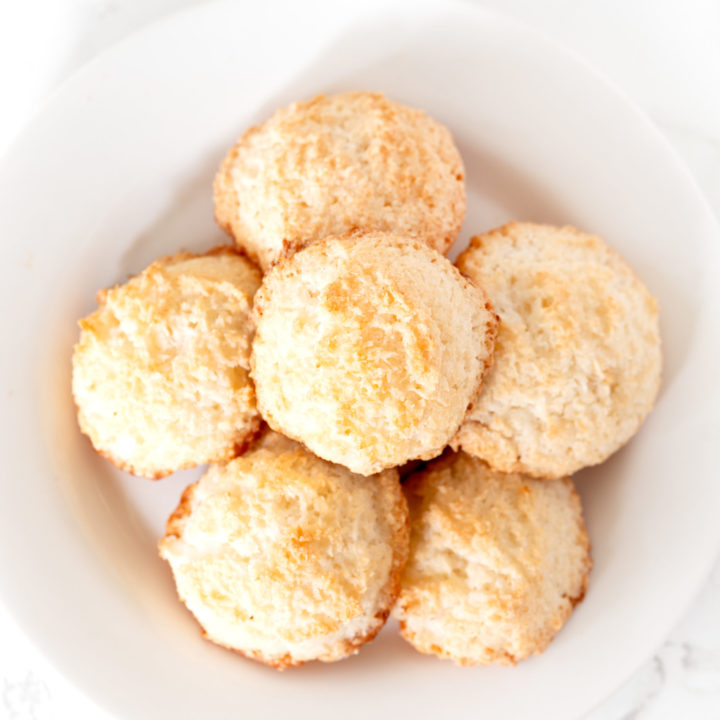
Macaroons are a delicious treat and are suprisingly easy to make! These homemade macaroons taste better than store bought and you can dip them in chocolate to mkae them extra special.
Ingredients
- 2 egg whites
- ¼ teaspoon vanilla extract
- Pinch of salt
- ⅔ cup granulated sugar
- 1 ½ cups sweetened coconut flakes or grated coconut
- 4 ounces semi-sweet chocolate, optional
Instructions
- Beat egg whites, vanilla, and salt together until soft peaks form.
- Gradually add sugar, beaten until very stiff and glossy.
- Fold in coconut.
- Place teaspoon sized mounds 2-inches apart onto a baking paper lined baking sheet.
- Bake for 20 minutes or until set and lightly golden brown.
Pre heat oven to 325°F or 160°C.
For macaroons dipped and drizzled in chocolate:
- Melt the chocolate in a microwave-safe bowl, stopping to stir every 30 seconds, until just smooth and creamy (or melt in a double boiler over simmering water).
- Dip the bottoms of the macaroons in the chocolate and return to the lined baking sheets and drizzle chocolate over the top.
- Refrigerate for about 10 minutes, or until the chocolate is set.

Hi, I'm ElissaBeth!
I created The Taste of Kosher to give you delicious, easy-to-make recipes you can feel proud to serve. I don't believe there are bad cooks and bakers, only bad recipes. I also believe that kosher and allergy-friendly recipes can and should taste just as good as the originals, and it's my mission to prove it.