
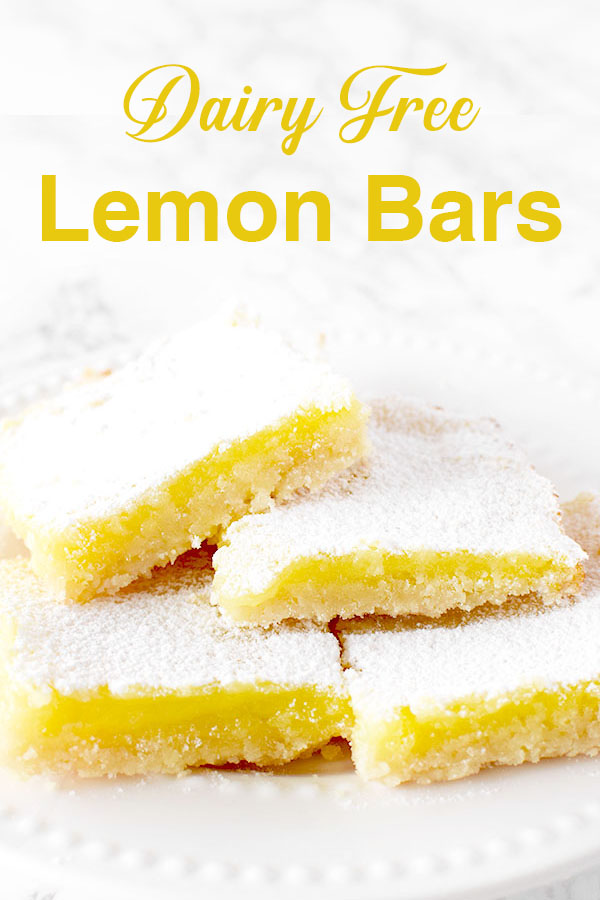
Dairy free lemon bars are a sunshiny dessert. They have a tasty shortbread bottom and a bright custard filling. This dessert is easy to make, but never fails to impress.
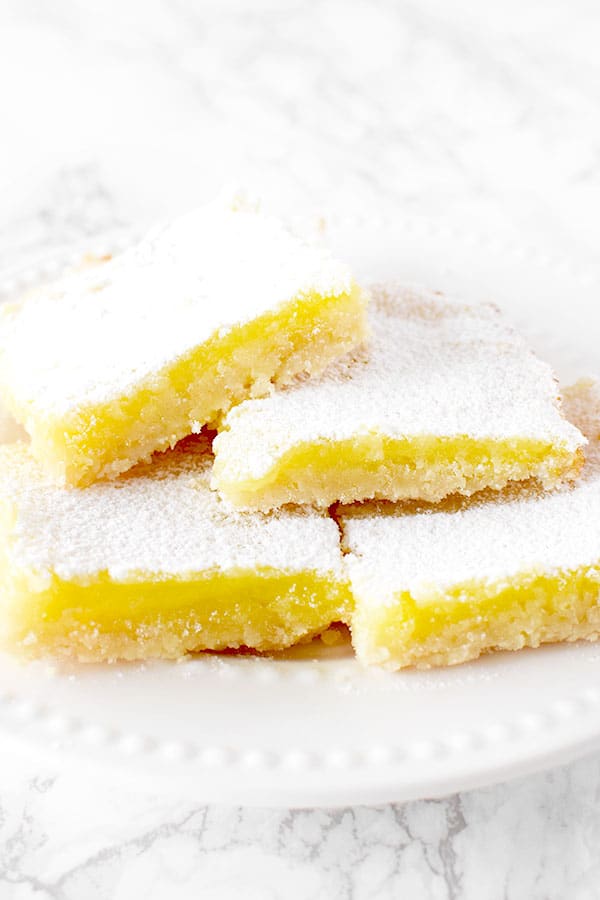
These lemon bars are summer captured into a dessert. They're sweet, fresh, and feel oh so indulgent with every bite!
And, somehow, they taste buttery even though they don't have butter in them!
I've had a lemon tree in my back yard for over a decade, and this is one of my favorite ways to them.
⭐⭐⭐⭐⭐
"I made these tonight for my daughter's 28th birthday as Lemon Bars are her favorite. She's nursing and avoiding dairy so my go to recipe was out of the question. Keeping my fingers crossed I thought I'd try this recipe and they certainly did not disappoint! I doubled the filling and it worked out perfectly! My daughter loved them!"
Doreen L Stuchinsky
Jump to:
- Recipe Update
- How to Measure Flour and Other Dry Ingredients
- Why Does This Recipe Use Oil?
- Which Type Of Oil should i Use?
- Sugar
- How to Store Sugar
- Do Eggs Need to Be at Room Temperature?
- Baking with Humidity
- Adjusting for a Convection Oven
- HOW TO DOUBLE THE RECIPE
- Troubleshooting
- make ahead of time
- How to store
- Do lemon bars have to be refrigerated?
- How to freeze
- Recipe Tips
- SNAFU
- Other Lemon Recipes You May Like
- Dairy Free Lemon Bars
Recipe Update
I doubled the lemon mixture so it would be taller and even more indulgent.
How to Measure Flour and Other Dry Ingredients
The best way to measure dry ingredients is with a scale, but in the United States, dry measuring cups are usually used instead.
Weighing ingredients is useful for home bakers, but it's especially important for professional bakers because they work with huge batches.
I usually use dry measuring cups when baking too, because I didn't grow up in a country that generally weighs ingredients, so please don't feel like you can't use them.
To measure most dry ingredients, first spoon them into a dry measuring cup and then level off the measuring cup with an upside-down butter knife.
Make sure not to pack it down because this will cause you to use more of the ingredient than the recipe calls for.
Brown sugar is the exception to the rule, though. To measure brown sugar, pack it into the measuring cup and then level off any excess.
To measure chocolate chips, nuts, or dried fruit, just pour them into the dry measuring cup and then level them off.
What are dry measuring cups?
Dry measuring cups are the set of cups that usually come with measuring spoons. Each cup is a different measurement, just like each spoon is a different measurement.
Liquid measuring cups, on the other hand, are the cups that usually hold more than one cup and have lines on the side that mark the measurements.
The problem with using liquid measuring cups to measure powdery dry ingredients, like flour and cocoa, is that you shake the cup to level them off. This causes the powder to settle, and you end up with more than you need.
I tested this with a friend who didn't believe me, and we ended up with a quarter cup more flour than the recipe called for.
Should I sift the flour and other dry ingredients?
It's usually recommended to sift your powdery ingredients, like flour and cocoa, before using them.
Sifting aerates the flour and removes any lumps, which helps make baked goods fluffier.
It also helps you get a more accurate measurement than when you use flour that's been packed tightly in a bag.
And sifting dry ingredients together, like flour, cocoa, and baking powder, helps make sure they're evenly distributed in the batter. Which honestly, I think is probably overrated, so I personally never bother with it.
Why Does This Recipe Use Oil?
Cakes, cupcakes, muffins, and quick breads made with oil usually bake up taller, have a better crumb, and a lighter texture than ones made with butter.
They also tend to stay moist and tender longer.
In fact, some recipes call for both oil and butter, instead of only butter, if they want a lighter and airier texture while still keeping the butter flavor.
I created a baking with oil - butter to oil conversion chart for you in case you want to convert some of your butter recipes to oil recipes.
Which Type Of Oil should i Use?
I don't specify in the recipe which type of oil to use because it's mostly personal preference and I don't want anyone to feel they have to use specifically that type of oil. For the most part, you can use whatever oil you feel most comfortable using.
I use neutral oils like canola oil, safflower oil, and vegetable oil.
You can also use stronger oils like olive oil and coconut oil, but keep in mind that they may change the taste somewhat.
If you're going to use olive oil, use the one labeled pure olive oil because it has the mildest flavor. This should make the flavor a lot less noticeable.
Is It Better to Use Canola Oil or Olive Oil?
Canola oil is relatively cheap and, due to its lack of flavor and high smoke point, is very versatile.
Olive oil, on the other hand, is generally considered a healthier choice.
So, really, it's whatever you prefer.
How to Store Oil
Store oils in a cool, dark place to prevent them from becoming rancid.
If you store them in the fridge, some oils, like olive oil, may solidify and look strange, but don't worry, they'll return to normal at room temperature.
Coconut oil begins to solidify in temperatures under 76°F or 25°C.
Sugar
The primary role of sugar is to be a sweetener. However, sugar also contributes to the tenderness and moistness of the baked good by absorbing and retaining moisture and helps create the golden brown color when baking as it caramelizes.
Recipes with more sugar often result in softer, moister textures. However, I learned the hard way that too much sugar leads to a sticky mess.
When it's heated, sugar caramelizes, resulting in a rich, complex flavor and a brown color. This adds both flavor and color to baked goods and is also the process in which caramel sauce, dulce de leche, caramel candies, and regular candies are made.
When used in recipes containing yeast, the sugar is eaten by the yeast, producing carbon dioxide and causing the dough to rise.
Sugar also acts as a preservative in jams, jellies, and fruit preserves by reducing water activity and preventing microbial growth.
There are many different types of sugar, including white sugar, brown sugar, vanilla sugar, powdered sugar, turbinado sugar, and demerara sugar.
When a recipe calls for "sugar" without specifying anything else, it's referring to regular white sugar.
White Sugar
White sugar (sometimes called granulated sugar, table sugar, or white granulated sugar) is made of either beet sugar or cane sugar, which has undergone a refining process.
It is the easiest to find and most commonly used.
Brown Sugar
Brown sugar is white sugar with molasses added to it.
It is commonly used in chocolate chip cookie recipes, and it's rare for a recipe that calls for brown sugar not to also call for white sugar as well.
When a recipe calls for "brown sugar" but doesn't specify what type (light or dark), it is referring to light brown sugar.
In my recipes, you can use whatever type of brown sugar you have on hand, whether it is dark brown sugar, light brown sugar, or demerara sugar - which is very common in Israel.
Just keep in mind that the flavor and color will be slightly different, depending on what you choose to use.
Turbinado Sugar
Turbinado sugar is better known as "raw sugar." But, despite this name, the sugar is not really "raw."
Instead, it's partially refined sugar that retains some of the original molasses.
The term "raw sugar" may also give off the impression that it is somehow healthier.
In reality, turbinado sugar is nutritionally similar to white sugar.
Demerara Sugar
Demerara sugar is very popular in Israel and is especially delicious in tea, but is also used for baking.
Unlike white sugar, demerara sugar undergoes minimal processing and retains some vitamins and minerals.
However, it is still not much healthier than white sugar.
Vanilla Sugar
Vanilla sugar is not very common in the States. However, it is common in Israel and parts of Europe.
This is sugar that sat for an extended period of time with vanilla beans, giving it a vanilla flavor.
Caster Sugar
This type of sugar is common in the United Kingdom.
It has a grain finer than white (granulated) sugar and larger than powdered sugar.
Caster sugar is often called for in recipes for delicate baked goods like meringues, souffles, and sponge cakes.
You can use a 1:1 conversion rate between caster sugar and white (granulated) sugar.
Powdered sugar
Powdered sugar, sometimes known as confectioners' sugar, is a sugar with a powdered texture.
This sugar is rarely used for baking. Instead, it is used for dusting desserts and making frosting, icing, and glazes.
In some countries, you can also find powdered vanilla sugar.
It is made the exact same way regular vanilla sugar is made. However, the sugar used is powdered instead of granulated.
Vanilla Extract vs Vanilla sugar
In my recipes, I don't specify what kind of vanilla to use.
The reason for this is that in the States, vanilla extract is exclusively used.
Meanwhile in Israel, along with many European countries, vanilla sugar is common.
In most, if not all recipes, both vanilla extract and vanilla sugar can be used.
In recipes where vanilla sugar can be used instead of extract, you can replace them 1:1.
Replacing Sugar with Honey
If you'd prefer to use honey instead of sugar, you can do so with pretty good results.
Honey can be two or even three times as sweet depending on the honey, so for every 1 cup of sugar, you can use ½ to ⅔ cup honey.
Since honey adds liquid, you need to remove some to balance it out. For every cup of honey, remove a ¼ cup of liquid.
Also, it burns faster than granulated sugar, so you want to lower the baking temperature by 25°F. In addition, check it early and often to avoid burning or overbaking.
How to Store Sugar
Sugar should be stored in an airtight container to prevent clumping and moisture absorption, and kept in a cool, dry place.
Do Eggs Need to Be at Room Temperature?
The short answer is "no."
While a lot of recipes call for room-temperature eggs, the difference is only noticeable if you do a side-by-side comparison, and even then, the difference is very slight.
Are Eggs Dairy?
No, eggs are not dairy.
Dairy is milk and any food products made from milk, including cheese, cream, butter, and yogurt.
So, while eggs are an animal product, they are not dairy.
Recipes like scrambled eggs made without milk are dairy free even though they contain eggs, since they do not use milk or butter.
If this sounds like a silly question to you, you'd be surprised how many people think eggs are dairy because they're in the refrigerated section of the supermarket.
How Can I Tell if My Eggs Are Still Good?
Fill a glass with cool water and submerge the eggs.
If the eggs sink to the bottom and lay flat on their side, they're still fresh.
If they sink but stand on one end at the bottom of the glass, the eggs are older but still good to use.
If an egg floats to the top, it's very old and should be checked carefully for signs of spoilage before using.
Baking with Humidity
Humidity can have a big impact on how your baked goods come out.
This is because when humidity is extremely high (think 70 percent or more), baking ingredients like flour, sugar, salt, baking powder, and baking soda soak up moisture from the air.
This can negatively impact the outcome of your cakes, cookies, yeast breads, and quick breads.
There are some things you can do to try to save your baking.
Try to counterbalance the additional moisture
To help counterbalance the additional moisture your dry ingredients soak up from the air, try reducing the amount of liquid in the recipe by about one quarter.
If the batter or dough looks too dry once all the ingredients are mixed together, add additional liquid a tablespoon at a time until you have the desired consistency.
This is not usually possible to do for cookies, but it does work for cakes and breads.
Store Ingredients in the Fridge
If flour and sugar are stored in the refrigerator or freezer rather than in a cupboard or pantry, they are better protected from humidity.
As an added benefit, keeping these ingredients cool also helps keep them fresher longer, in addition to helping them stay bug-free.
For the best results, let them warm to room temperature before using.
Bake for Longer
If you bake your goodies for a few extra minutes, it can help the liquid to cook off.
To avoid overbaking, continue testing for doneness every couple of minutes for breads, quick breads, cakes, cupcakes, and muffins. Cookies, on the other hand, need to be checked every minute.
Use Air Conditioning
To help lower humidity levels on humid summer days, air condition the room for at least an hour before you start baking.
Cooler air isn't able to hold as much moisture as warm air.
Store your baked goods in an airtight container
Humidity can also ruin your fresh-baked goods because when they are left out, they can absorb moisture.
To avoid this, store them in an airtight container or resealable bag.
Adjusting for a Convection Oven
Convection ovens blow the hot air around, producing around 25 to 30 percent more heat.
Since convection ovens produce more heat, you need either lowering the temperature or shortening the cooking time to compensate.
When recipes specify temperatures and cooking times, it's for conventional ovens, unless specified otherwise.
A simple rule to follow is to lower the temperature by 25ºF or 14ºC when baking cookies and pies, and 50ºF or 28ºC when roasting meat and poultry. Some convection ovens offer separate settings for baking and for roasting.
You can also leave the temperature the same and instead, shorten the cooking time by 25 percent. For example, if your recipe calls for 60 minutes in the oven, check the food after 45 minutes instead.
However, keep in mind, some convection ovens actually make a heat adjustment for you. That is, if you set a convection oven for 350ºF, it might actually set itself to 325ºF to compensate. So, check your manual before making adjustments.
HOW TO DOUBLE THE RECIPE
If you double the recipe, you will need a 9 x 13-inch pan.
Troubleshooting
Even though this recipe is very easy to make, life happens and things sometimes don't go as expected.
Why don't they have the right texture?
Removing lemons bars too early from the oven can cause them to be runny. Also, not giving them enough time to set after removing them can make them gooey.
Why is it taking longer than described to bake?
Over time, the thermostat on ovens gets a little off, causing some ovens to run hot and others to run cool. This is why recipes tend to say things like "10 to 15 minutes or until golden brown."
So, if it takes you longer than expected, that's fine. Don't worry about it. Just keep baking until ready.
Why did it come out dry?
Just like some ovens run cool, others run hot. If your oven runs hot, bake these at a lower temperature.
Ideally, you should get an oven thermometer to know what temperature you're really baking at.
Why did it burn?
If you baked it for the right amount of time, then burning is usually caused by two reasons.
The first is if you put them on the lower shelf in the oven.
The second is if the bottom of your oven has food particles that dripped onto it. Even a small bit of food that drips down could cause an oven to have problems heating properly and burn the cookies.
Why did it come out too wet?
Check your measuring cups. Sometimes measuring cups aren't accurate, and if you are using different sets of wet and dry measuring cups and measuring spoons from different brands, they may not match.
I've had sets that were a ¼ cup off.
To test your sets, fill your dry and wet measuring cups with 16 tablespoons. If 16 tablespoons doesn't fill a cup, your measuring cups are too big.
If it takes you less than 16 tablespoons to fill up a cup, your spoons are too big.
I've actually mixed and matched sets of spoons and cups that are too big because they matched each other, even if they weren't accurate.
Technically, it could also be that your cups or spoons are too small, but I haven't seen that happen before.
Why did Cookie Bottom came out too crumbly?
Your measuring cups and spoons may be off. This is why pastry chefs weigh everything.
To test this, take your measuring spoons, liquid measuring cup, and dry measuring cups and compare them to each other. I do this by filling the dry measuring cup with 16 tablespoons of water.
If it fills it perfectly, then I know that it's right. Next, I pour the water from the dry measuring cup to the liquid measuring cup. If it's a full cup, no more and no less, then they all match.
To avoid this, it is best to buy sets of measuring spoons and dry measuring cups. This is very helpful because sets are usually made to match each other. However, you still need to make sure that your liquid measuring cup matches as well.
Something went wrong, I can't even explain it... what happened?
When this has happened to me, it's been because I overstuffed the oven.
Make sure to bake the recipe on the middle shelf in the oven, and only a normal amount at a time.
I once tried to make a bunch of brownie recipes all at once, and I think I may have had something on the bottom shelf too because I was in a rush, and it came out terrible.
I can't even describe what was wrong with it. It was just very, very wrong.
make ahead of time
You can make lemon bars ahead of time. If you are making them up to a few days early, you can store them in the fridge.
However, if you're intending on storing them for any longer than that, freeze them.
How to store
Let cool and set completely. Lightly cover the lemon bars with plastic wrap and refrigerate for up to 4 days. After that, the quality begins to degrade.
Do lemon bars have to be refrigerated?
Yes. Since lemon bars are a custard, they should be refrigerated if they are not going to be served the same day.
However, they are fine to keep out at room temperature for a few hours - if the weather is not too warm - while served at a party.
How to freeze
For a whole pan
Let uncut lemon bars cool and set completely. Do not add powdered sugar. Instead, wrap the lemon bars in wax paper and again tightly in plastic wrap. Store it in a resealable freezer bag.
When ready to use, let them defrost, top them with powdered sugar, and cut them into squares. Store for up to four months.
For cut lemon bars
Wrap each lemon bar in wax paper, then wrap each bar tightly with plastic wrap. Place them all in a large resealable plastic bag. Store for up to four months.
Recipe Tips
If you don't line the pan with parchment paper, the shortbread bottom is more likely to crumble. To make it even easier, allow "wings" of parchment paper to stick out of the side for an easy "air lift" removal.
Also, if you don't have a fresh lemon, ¼ cup of lemon juice will work in a pinch.
SNAFU
I forgot to grease and flour my non-stick baking pan before making these. Big mistake they were tough to get out, difficult to clean, and I scratched up the bottom of the pan.
I realized when I was done I should have used plastic to prevent scratching. Also, I was worried a spatula would be too big and ruin them. So, without thinking, I went for the smallest thing I could find.
Other Lemon Recipes You May Like
You may also like to try one of my many other dairy free desserts.
Dairy Free Lemon Bars
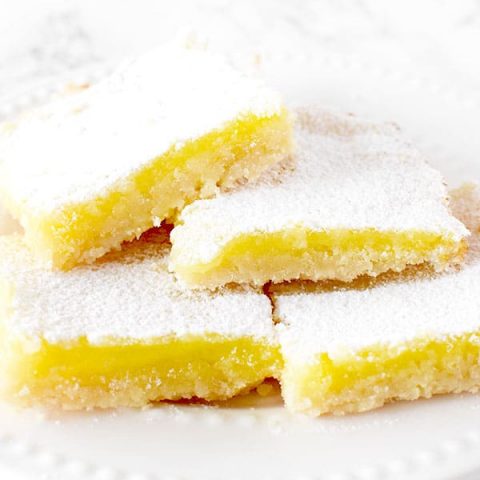
These are the perfect dairy free lemon bars and they use only one bowl to make for easy clean up.
Ingredients
Crust
- 1 cup all-purpose flour (120 grams)
- ¼ cup white sugar (50 grams)
- 6 tablespoons oil (70 grams)
- Pinch salt
Lemon Filling
- 4 eggs
- 2 medium lemon, juiced
- 1 ½ cup sugar (300 grams)
- ¼ cup all-purpose flour
Dusting
- 1 tablespoon powdered sugar
Instructions
- Preheat the oven to 350°F or 175°C.
- In a mixing bowl, combine flour, sugar, oil, and salt. Press to the bottom of a parchment paper lined 8 x 8 inch pan.
- Bake for 15 to 20 minutes, until lightly golden brown.
- Whisk together eggs, lemon juice, sugar, and flour. The filling should be runny.
- When the crust is ready, remove it from the oven and pour the mixture into the pan. Bake for another 20 minutes.
- Remove and let cool completely before cutting. Dust with powdered sugar.
Notes
If you don't line the pan with parchment paper, the shortbread bottom is more likely to crumble. To make it even easier, allow "wings" of parchment paper to stick out of the side for an easy "air lift" removal.
Nutrition Information:
Yield:
9Serving Size:
1Amount Per Serving: Calories: 236Total Fat: 9gSaturated Fat: 1gTrans Fat: 0gUnsaturated Fat: 8gCholesterol: 41mgSodium: 31mgCarbohydrates: 35gFiber: 0gSugar: 23gProtein: 3g

Hi, I'm ElissaBeth!
I created The Taste of Kosher to give you delicious, easy-to-make recipes you can feel proud to serve. I don't believe there are bad cooks and bakers, only bad recipes. I also believe that kosher and allergy-friendly recipes can and should taste just as good as the originals, and it's my mission to prove it.
Hi! Do you think that this would work with 2 egg yolks instead of 2 eggs?
Probably not since you need the liquid and structure provided by the egg whites as well as the egg yolks.
Would this work on a 9x9 pan or would it be too thin?
It would be thinner... but too thin is relative to your preference. Technically it should work.
The curd came out very nice. Crust was a bit thick for me. I made a quadruple recipe, and if I were to do it again, I would probably only do double for the crust, quadruple for the curd for a better balance.
I'm glad you liked it. I agree that I would no more than double the crust if I was making a taller lemon bar, I am not even sure that I would double the crust since the main idea would be to have more curd.
These turned out really nice. I put them in for a touch too long so the top ended up a bit rubbery (my bad) oops!
I'm happy to hear you enjoyed them 🙂
Another excellent recipe
I'm happy to hear it 🙂
Can I use whole wheat flour?
I haven't tried it but I don't see why not.
Can you use coconut or almond flour with this? Also what about stevia for the filling or crust? I know I don’t want to change the texture of the filling so I wanted to ask before I proceeded.
If you want to use coconut or almond flour I'd recommend using a combination of the two since almond flour doesn't soak up as much liquid as flour does and coconut flour soaks up a lot. I cannot give you ratios though since I've never tried it.
I've also never used stevia so you may want to look for instructions from the package you are using for a conversion rate.
I hope that helps.
Hi! I tried it, and I love the crust. The filling for me is very sweet though, is there a way to replace some of the sugar with flour without affecting the consistency?
I wouldn't replace the sugar with flour. They have two completely different purposes in a recipe. You can just cut the sugar instead.
This is the first time I've made lemon bars. I'm not sure why this happened (maybe because I used 80% whole wheat maybe my scale is working correctly) but ...I weighed out the 120 grams of flour, and then out of curiousity, I measured it in a measuring cup. It was only 3/4 of a cup but since you mentioned that weighing is more accurate, I went with the weight and didn't add flour. The mixture came out very loose, sort of between a cake and a cookie, but since I've never made it before I went along with that. After it was baked, I added, the lemony part on top and baked it again.
To my surprise, when I took it out of the over, the lemony part was on the bottom and the shortbread was on the top! I kid you not.
After it cooled I flipped the whole thing over and it looked like a normal lemon bar. I know this sounds crazy. Anyway, just thought I would share. I actually took a picture and sent it on whatsapp to my sister, who does make lemon bars, to ask if this is what is supposed to happen. She said no. 🙂
They tasted fine, btw.
I guess what happened is that the lemony part was so much heavier that it just sank right through the shortbread part, which I guess hadn't solidified because it didn't have enough flour.
That is one of the funniest things I've ever heard happen with a recipe! Thanks for sharing it with me I've been sick for days and really needed a good laugh 😀 I'm also glad it came out good anyway!
Did you happen to get your measuring cup from Fox Home? Those are made way too big and their measurements are way off. When I made these same lemon bars with them the texture came out just as you described. Likewise, over sized measuring spoons (I have a set of those too unfortunately) would cause the same problem.
Believe it or not, the size of measuring cups and spoons are not regulated, so companies can say they are whatever size they want and that will mess up your recipe. This is why grams are more reliable. Many recipes are forgiving so it will only be noticeable with some and not others.
I actually often measure liquid in dry measuring cups because I know it will match the amount of dry ingredients I put in using those same cups. And since dry measuring cups usually come in a set with measuring spoons those usually match as well.
@Lisa, In the process of looking for a recipe for a lemon bar, I came across the answer to your problem. You have to add the lemon topping right after you take the crust out of the oven. This way, the egg in the lemon custard will partially cook from the heat of the crust and it won't sink.
If you let the crust cool, it will sink through.
@Lisa, Omg, that is so something that would happen to me! Love,the fact it tasted good. Had to reach out, I needed that laugh, today. I just picture so many crazy mishaps that I somehow, through the back door, it turned out good. TY for ur share!
Can I use bottled lemon juice?
It should work. It would be about 3 tablespoons.
What a great recipe. I actually moved to israel a few months ago from NY, and we too have a lemon tree. Small world!
You moved just in time to beat the cold! Since moving I've been trying to make anything lemon I can think of because of the abundance of trees?
Thank you, the recipe is super helpful! Love that it’s pareve too!!
I’m glad to hear it Sapir! Thank you 🙂
I loved this recipe! I used coconut oil and honestly couldn’t taste a big difference. I’ll be using this recipe for many years I’m sure
I'm so glad to hear it!
If I want to make in 9x13 would I have to double or triple?
You'd double it
What kind of oil did you use? Can I use olive oil? I’ll meeting my boyfriends family this weekend at a bbq and would love to make them this! 🙂
I use a neutral oil when I make them but I think coconut oil could give a nice flavor, olive oil may work but also may be too strong, I've never tired it.
I made these tonight for my daughter's 28th birthday as Lemon Bars are her favorite. She's nursing and avoiding dairy so my go to recipe was out of the question. Keeping my fingers crossed I thought I'd try this recipe and they certainly did not disappoint! I doubled the filling and it worked out perfectly! My daughter loved them!?
I am so happy to hear that Doreen!
How long did you bake it for when doubling the filling?
For the same amount of time or until it looks like it's set.
@ElissaBeth, can i use avicado oil
I don't see why not though I've never tried baking with it before.