
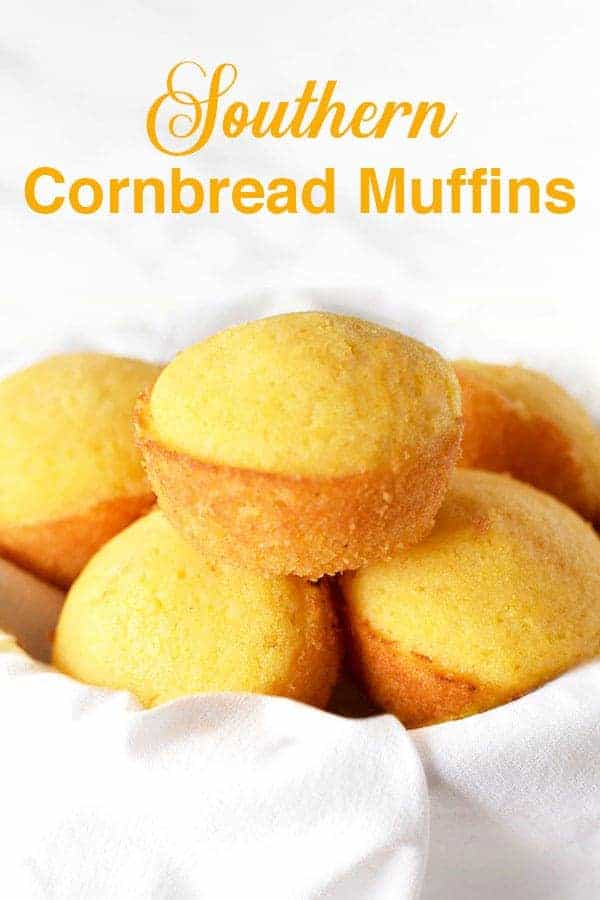
Southern cornbread muffins are a savory side dish that adds a Southern touch to any dinner. For an authentic dish, serve with fried chicken and collard greens.
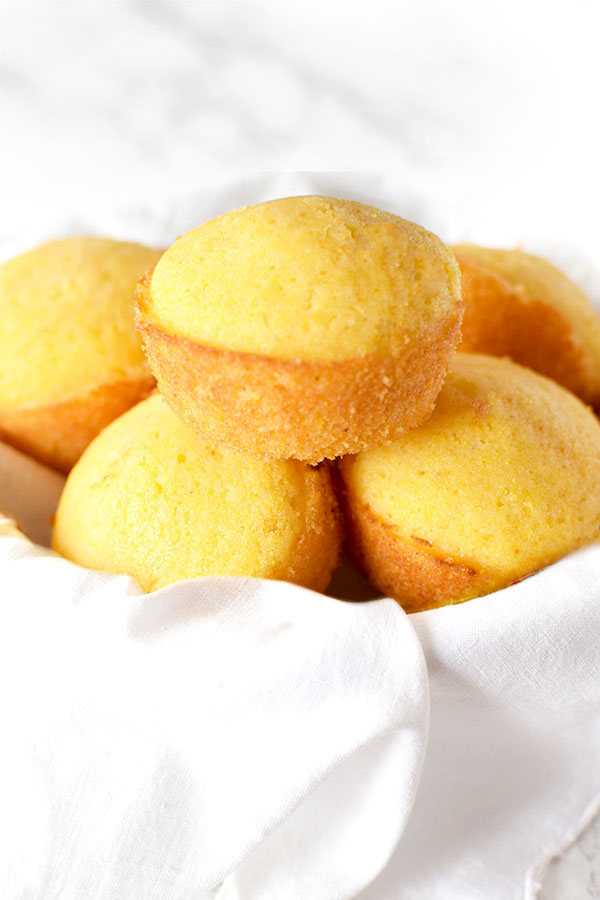
These Southern style cornbread muffins are moist with a perfect crumb.
What I like about them over classic skillet cornbread is that you don't need to bother cutting them. Just pop them out of the tin and they are ready to be served.
Unlike Northern sweet cornbread muffins which are usually eaten for breakfast - or at least that's the way I eat them - Southern savory cornbread muffins are served for dinner.
At least that is what I'm told by my friend Christopher from Georgia. However, my friend Mack from Texas says they can also be eaten for lunch.
Traditionally they are eaten all year round. My favorite time of year to serve these though is actually Thanksgiving.
I'm not sure where I got the idea to make cornbread for Thanksgiving.
Being from California and New York, my family never did it since it is more popular in parts of New England and the South.
It could be I picked it up from my friends in Massachusetts.
Either way, it seemed like a nice addition so I started making it as part of my Thanksgiving menu and my family approved.
Jump to:
- How to Measure Flour and Other Dry Ingredients
- Why Does This Recipe Use Oil?
- Which Type Of Oil should i use?
- Do Eggs Need to Be at Room Temperature?
- Can I Make This Without Using Eggs?
- What kind of sugar should I use?
- Can I use honey instead of sugar?
- Can I use baking soda and baking powder interchangeably?
- SNAFU:
- how to store
- how to freeze
- Other Recipes You May Like:
- Southern Cornbread Muffins
How to Measure Flour and Other Dry Ingredients
The best way to measure dry ingredients is with a scale, but in the United States, dry measuring cups are usually used instead.
Weighing ingredients is useful for home bakers, but it's especially important for professional bakers because they work with huge batches.
I usually use dry measuring cups when baking too, because I didn't grow up in a country that generally weighs ingredients, so please don't feel like you can't use them.
To measure most dry ingredients, first spoon them into a dry measuring cup and then level off the measuring cup with an upside-down butter knife.
Make sure not to pack it down because this will cause you to use more of the ingredient than the recipe calls for.
Brown sugar is the exception to the rule, though. To measure brown sugar, pack it into the measuring cup and then level off any excess.
To measure chocolate chips, nuts, or dried fruit, just pour them into the dry measuring cup and then level them off.
What are dry measuring cups?
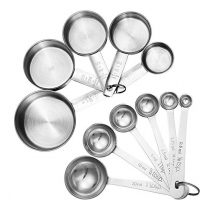
Dry measuring cups are the set of cups that usually come with measuring spoons. Each cup is a different measurement, just like each spoon is a different measurement.
Liquid measuring cups, on the other hand, are the cups that usually hold more than one cup and have lines on the side that mark the measurements.
The problem with using liquid measuring cups to measure powdery dry ingredients, like flour and cocoa, is that you shake the cup to level them off. This causes the powder to settle, and you end up with more than you need.
I tested this with a friend who didn't believe me, and we ended up with a quarter cup more flour than the recipe called for.
Should I sift the flour and other dry ingredients?
It's usually recommended to sift your powdery ingredients, like flour and cocoa, before using them.
Sifting aerates the flour and removes any lumps, which helps make baked goods fluffier.
It also helps you get a more accurate measurement than when you use flour that's been packed tightly in a bag.
And sifting dry ingredients together, like flour, cocoa, and baking powder, helps make sure they're evenly distributed in the batter. Which honestly, I think is probably overrated, so I personally never bother with it.
Why Does This Recipe Use Oil?
Cakes, cupcakes, muffins, and quick breads made with oil usually bake up taller, have a better crumb, and a lighter texture than ones made with butter.
They also tend to stay moist and tender longer.
In fact, some recipes call for both oil and butter, instead of only butter, if they want a lighter and airier texture while still keeping the butter flavor.
I created a baking with oil - butter to oil conversion chart for you in case you want to convert some of your butter recipes to oil recipes.
Which Type Of Oil should i use?
I don't specify in the recipe which type of oil to use because it's mostly personal preference and I don't want anyone to feel they have to use specifically that type of oil. For the most part, you can use whatever oil you feel most comfortable using.
I use neutral oils like canola oil, safflower oil, and vegetable oil.
You can also use stronger oils like olive oil and coconut oil, but keep in mind that they may change the taste somewhat.
If you're going to use olive oil, use the one labeled pure olive oil because it has the mildest flavor. This should make the flavor a lot less noticeable.
Is It Better to Use Canola Oil or Olive Oil?
Canola oil is relatively cheap and, due to its lack of flavor and high smoke point, is very versatile.
Olive oil, on the other hand, is generally considered a healthier choice.
So, really, it's whatever you prefer.
How to Store Oil
Store oils in a cool, dark place to prevent them from becoming rancid.
If you store them in the fridge, some oils, like olive oil, may solidify and look strange, but don't worry, they'll return to normal at room temperature.
Coconut oil begins to solidify in temperatures under 76°F or 25°C.
Do Eggs Need to Be at Room Temperature?
The short answer is "no."
While a lot of recipes call for room-temperature eggs, the difference is only noticeable if you do a side-by-side comparison, and even then, the difference is very slight.
How Can I Tell if My Eggs Are Still Good?
Fill a glass with cool water and submerge the eggs.
If the eggs sink to the bottom and lay flat on their side, they're still fresh.
If they sink but stand on one end at the bottom of the glass, the eggs are older but still good to use.
If an egg floats to the top, it's very old and should be checked carefully for signs of spoilage before using.
Can I Make This Without Using Eggs?
Yes. All you have to do is replace each egg with ¼ cup of water.
How Do I Replace Eggs in Recipes?
After being asked by a mother how she could make one of my dairy free recipes for her child who is allergic to eggs, I did a lot of research into it and started making egg free recipes too. I'm here to help you know 🙂
So, if you want to make pretty much any recipe eggless, here's how you do it:
Eggs do three things in most recipes: they help bind the ingredients together, help them rise, and add moisture.
For example, eggs are the primary binder in a pumpkin pie, creating a sliceable custard, but in my chewy brownies they mostly just help them rise.
So, to replace eggs in fluffy things like eggless chocolate cakes and eggless cornbread, use ¼ cup of water per egg called for.
For cookies like my eggless chocolate chip cookies, use 2 tablespoons of water in place of each egg.
In pies like eggless pumpkin pie or in recipes like eggless meatloaf, and really anything that uses eggs as a binder, use 1 tablespoon of cornstarch and ⅓ cup of water per egg. Though don't try this with matzo balls, because it doesn't work-believe me, I've tested it and ended up with a big mess.
What kind of sugar should I use?
You should use white granulated sugar, which is also called white sugar, granulated sugar, and table sugar.
If you live in the United Kingdom, you can use caster sugar instead.
You should not use powdered sugar, which is mostly used for dusting desserts and making frosting, icing, and glazes. But it is sometimes used to make fudge.
Can I use honey instead of sugar?
If you'd prefer to use honey instead of sugar, like I do in my honey challah recipe, you can. However, it may change the taste and texture somewhat.
Honey is sweeter than sugar, so you don't need as much of it. As a general rule, use ¾ cup of honey for every 1 cup of sugar.
- 1 cup sugar → ¾ cup honey
- ¾ cup sugar → ⅔ cup honey
- ½ cup sugar → 6 tablespoons honey
- ¼ cup sugar → 3 tablespoons honey
Honey also adds liquid to the recipe, so you'll need to reduce the other liquid. For every cup of sugar you replace with honey, reduce the other liquid by about 3 to 4 tablespoons.
- 1 cup honey → remove 3 to 4 tablespoons liquid
- ¾ cup honey → remove about 2¼ to 3 tablespoons liquid
- ½ cup honey → remove about 1½ to 2 tablespoons liquid
- ¼ cup honey → remove about 1 tablespoon liquid
If there isn't enough liquid in the recipe to remove, you can remove it from the egg whites instead, but NEVER remove it from the oil.
Honey also causes baked goods to brown more quickly. For this reason, avoid using honey in recipes that need to be baked at temperatures above 350°F or 175°C.
Can I use baking soda and baking powder interchangeably?
No. Even though baking soda and baking powder are both leavening agents that make things rise, they work differently and aren't generally interchangeable.
When baking soda (also known as sodium bicarbonate) is combined with acidic ingredients, it makes carbon dioxide. This helps batter or dough rise and gives baked goods a light, fluffy texture.
That's why baking soda is commonly used in recipes have acidic ingredients, like buttermilk, lemon juice, vinegar, or natural cocoa powder.
Baking soda is also roughly four times as powerful as baking powder, so you don't need a lot of it. Using too much can actually give your baked goods a bitter or metallic taste.
Baking soda needs enough acid to react with it, so substituting it for baking powder can leave things flat and tasting off.
Baking powder, on the other hand, is a combination of both baking soda and an acid, so it doesn't need an acidic ingredient in the recipe to create carbon dioxide.
This makes baking powder useful in recipes that don't have enough acidic ingredients to activate baking soda. For example, it's commonly used in recipes like matzo balls and biscuits.
Because baking powder is less powerful than baking soda, recipes generally call for more of it. So, if you try to use baking soda instead of baking powder, the texture won't come out right and the flavor will probably taste disgusting.
Why do some recipes call for both?
Some recipes use both baking soda and baking powder because they do slightly different things.
For example, my chocolate cake has enough acid for baking soda to react with it, but if you'd use enough baking soda to give the cake the lift it need, it would ruin the flavor and you'd have to throw the cake out.
So, instead of adding more baking soda, the recipe uses baking powder to give additional rise.
How can I tell if baking soda and baking powder are still good?
Both baking powder and baking soda can continue to be used well past their best by dates, but they become less potent over time and can eventually stop working altogether.
To test baking soda, pour 3 tablespoons of white distilled vinegar into a small bowl, add ½ teaspoon of baking soda, and stir. The mixture should rapidly bubble if the baking soda is still active.
To test baking powder, pour 3 tablespoons of warm water into a small bowl, add ½ teaspoon of baking powder, and stir. If the baking powder is still active, it should fizz.
SNAFU:
The first time I tried to make cornbread was for Thanksgiving. I was feeling so rushed I accidentally added a tablespoon of salt instead of a teaspoon.
Needless to say, it was extremely salty and not much of a hit. In fact, I was worried my family wouldn't give these chance... but after a little convincing, they did and really enjoyed them.
how to store
Let the muffins cool fully.
Transfer the muffins to an airtight container lined with a paper towel. Place another paper towel on top of the bread before sealing.
If using a zip-top plastic bag, line both sides of the bag with paper towels and remove as much air as possible before sealing the top of the bag.
Store at room temperature for up to 4 days.
how to freeze
Let the muffins cool fully. Wrap in plastic wrap, then place in a resealable freezer bag.
Freeze for up to 3 months. They will still be safe to eat after 2 to 3 months, but their quality begins to degrade.
When ready to eat, let thaw at room temperature. To give it a fresh-out-of-the-oven taste and texture, rewarm gently in an oven.
Other Recipes You May Like:
Southern Cornbread Muffins
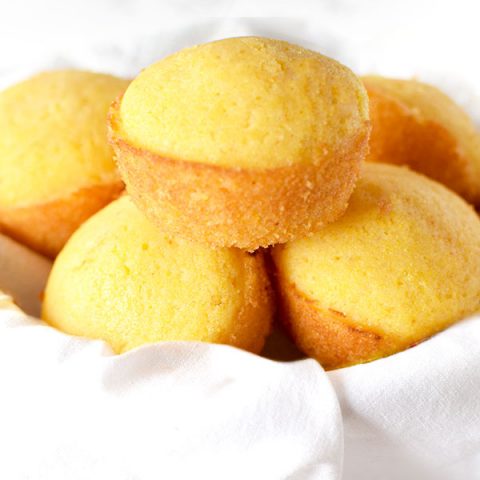
Southern cornbread muffins are a savory side dish that adds a Southern touch to any dinner.
Ingredients
- 1 cup cornmeal (160 grams)
- 1 cup all-purpose flour (130 grams)
- ¼ white sugar (50 grams)
- 1 tablespoon baking powder
- 1 teaspoon salt
- 1 cup water (235 milliliters)
- 1 egg, beaten
- ⅓ cup oil (80 milliliters)
Instructions
- Preheat the oven to 400°F or 205°C.
- Whisk together the cornmeal, flour, sugar, baking powder, and salt in a mixing bowl.
- Add water, egg, and oil. Mix until well incorporated.
- Using a ladle, pour into each cup of the muffin pan.
- Bake for 15 to 20 minutes, or until a toothpick inserted into the center comes out clean. Let cool completely before removing from the pan.
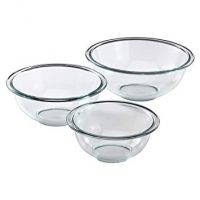
Recommended Products
Some of the links below are affiliate links, which means that if you choose to make a purchase, I will earn a small commission. This commission comes at no additional cost to you.

Nutrition Information:
Yield:
12Serving Size:
1Amount Per Serving: Calories: 141Total Fat: 7gSaturated Fat: 1gTrans Fat: 0gUnsaturated Fat: 6gCholesterol: 16mgSodium: 309mgCarbohydrates: 17gFiber: 1gSugar: 1gProtein: 3g
Which oil do you prefer to use for this recipe? I'm tempted to try olive oil, but curious about your preference. Thanks!
I generally use neutral flavored oils in my baking 🙂 If you want to try olive oil, I'd recommend not using EVO because I've never liked the way things came out when I used it instead of a neutral flavored oil
Wondering to what level you fill the muffin cups? 1/2? 3/4? All the way to the top?
1/2 or 3/4 are both fine depending on how big you want your muffins. I like to fill mine to around 3/4 but I just eye-ball it.
All that way to the top would be too high and probably make a big mess
Hi Elissabeth,
I couldn't bake to save my life when I came upon your recipe for banana muffins. I made them and they were perfect. Then I made them again as banana bread and it was divine. Then I tried your chocolate cake and it was amazing! My family are blown away that I have become a decent baker overnight. I laugh when I think how many times I attempted banana bread and it was awful! Thanks so much. I just wanted to ask you what corn meal is in South Africa. We have maize meal, is it the same or must I use something else like polenta?
Regards
Caroline
Caroline, this comment has made me so happy! Thank you for sharing it with me! I am so glad to hear that I was able to do that for you 🙂
I've never heard of maize meal before so I did a search. It looks like it is similar to cornmeal... but white instead of yellow and finer. I can't find any conversion rate anywhere... but I'd bet that you can use them. Just make sure to add enough that it has a thick batter-like consistency.
If you try it please let me know how it comes out! I'm really curious now.
I will do thank you so much! 🙂
Happy to help! 🙂