
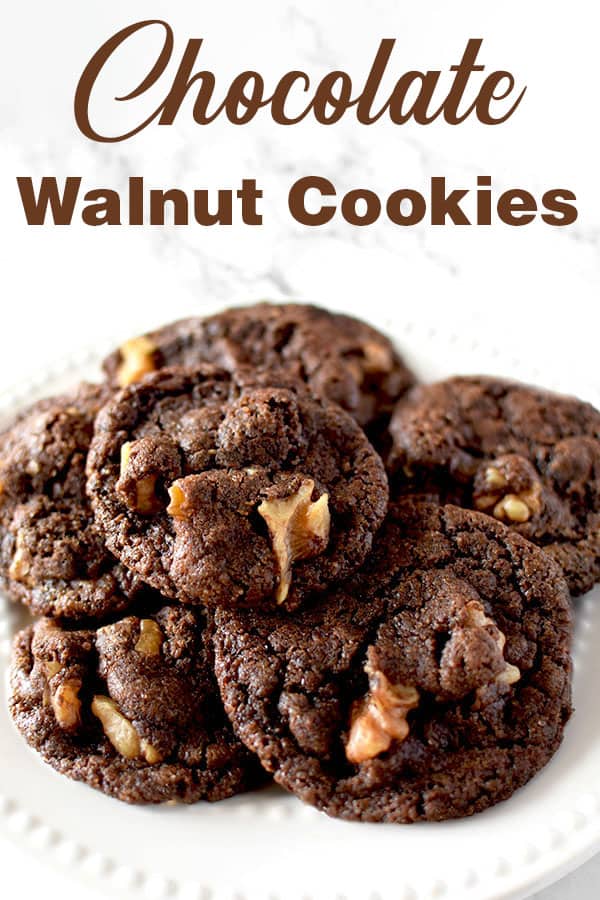
These chocolate walnut cookies are filled with rich chocolate flavor which is complemented by the nutty goodness. These are a chocolate nut lover's dream come true and are dairy free!
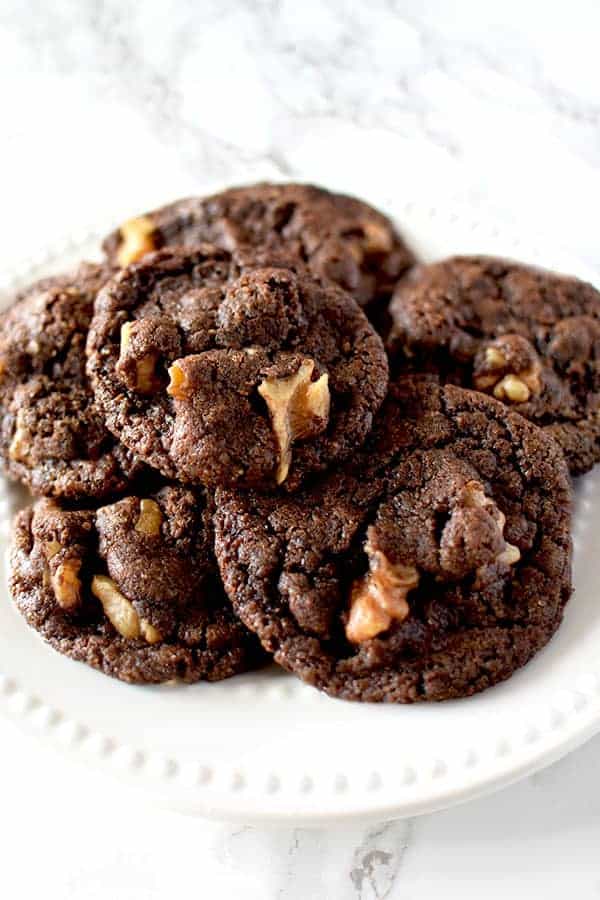
When I was growing up, my mom would make delicious chocolate walnut cookies. She would take boxed cake mix and tweak it to turn it into cookies and mix in walnuts.
They came out cakey (no surprise there!) with a rich chocolate nutty flavor that I loved. For me, the way the flavors of the chocolate and nuts came together was incredible!
It's been many years since my mom made those cookies. I think the last time I had them I was a teenager, but I never forgot the taste.
Come to think of it, I don't think I've ever seen chocolate walnut cookies in a bakery, so I am not even sure where she got the idea for them, but my only hope was to make them myself.
Now that I've been baking a lot for all of you wonderful readers, I decided to give them a go. I admit, they aren't exactly like the ones I grew up with. These are arguably better.
So, what I did was use the same recipe and just swapped in walnut for chocolate chips. No regrets! These are seriously incredible.
If you like these chocolate walnut cookies, you may also like my chocolate walnut muffins.
Or, you may like to try one of my many other dairy free desserts.
Jump to:
- How to Measure Flour and Other Dry Ingredients
- how do you make cookies with oil instead of butter?
- Which Type of Cocoa Should I Use?
- Do Eggs Need to Be at Room Temperature?
- Can I Make This Without Using Eggs?
- What kind of sugar should I use?
- an I use honey instead of sugar?
- What kind of brown sugar should I use?
- What Kind of Vanilla Should I Use?
- Can I use baking soda and baking powder interchangeably?
- troubleshooting
- how to store
- how to freeze
- Other dairy free cookies you make like:
- Chocolate Walnut Cookies
How to Measure Flour and Other Dry Ingredients
The best way to measure dry ingredients is with a scale, but in the United States, dry measuring cups are usually used instead.
Weighing ingredients is useful for home bakers, but it's especially important for professional bakers because they work with huge batches.
I usually use dry measuring cups when baking too, because I didn't grow up in a country that generally weighs ingredients, so please don't feel like you can't use them.
To measure most dry ingredients, first spoon them into a dry measuring cup and then level off the measuring cup with an upside-down butter knife.
Make sure not to pack it down because this will cause you to use more of the ingredient than the recipe calls for.
Brown sugar is the exception to the rule, though. To measure brown sugar, pack it into the measuring cup and then level off any excess.
To measure chocolate chips, nuts, or dried fruit, just pour them into the dry measuring cup and then level them off.
What are dry measuring cups?
Dry measuring cups are the set of cups that usually come with measuring spoons. Each cup is a different measurement, just like each spoon is a different measurement.
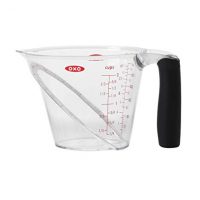
Liquid measuring cups, on the other hand, are the cups that usually hold more than one cup and have lines on the side that mark the measurements.
The problem with using liquid measuring cups to measure powdery dry ingredients, like flour and cocoa, is that you shake the cup to level them off. This causes the powder to settle, and you end up with more than you need.
I tested this with a friend who didn't believe me, and we ended up with a quarter cup more flour than the recipe called for.
Should I sift the flour and other dry ingredients?
It's usually recommended to sift your powdery ingredients, like flour and cocoa, before using them.
Sifting aerates the flour and removes any lumps, which helps make baked goods fluffier.
It also helps you get a more accurate measurement than when you use flour that's been packed tightly in a bag.
And sifting dry ingredients together, like flour, cocoa, and baking powder, helps make sure they're evenly distributed in the batter. Which honestly, I think is probably overrated, so I personally never bother with it.
how do you make cookies with oil instead of butter?
Making cookies with oil is a little bit different than making cookies with butter.
Since butter is about 80% fat and 20% water, and oil is 100% fat, you need less oil than you do butter.
However, that could lead to cookie dough with oil being drier and therefore harder to shape. This is not the case with cookies like crinkle cookies, but in most cases, it is.
So, it's really helpful to add a little bit of water to get a similar consistency to cookie dough made with butter.
I do this by adding a bit of water at a time and mixing it in before adding a little more until I get the right consistency. Usually, only 1 to 2 tablespoons of water does the trick.
Do oil cookies need to be chilled?
In most cases, I don't find chilling cookies made with oil necessary.
The one exception is for cookies you plan to cut out, like sugar cookies or gingerbread cookies, because chilled dough makes the cut-out shapes easier to work with.
Which Type Of Oil to Use
I don't specify in the recipe which type of oil to use because it's mostly personal preference and I don't want anyone to feel they have to use specifically that type of oil. For the most part, you can use whatever oil you feel most comfortable using.
I use neutral oils like canola oil, safflower oil, and vegetable oil.
You can also use stronger oils like olive oil and coconut oil, but keep in mind that they may change the taste somewhat.
If you're going to use olive oil, use the one labeled pure olive oil because it has the mildest flavor. This should make the flavor a lot less noticeable.
Is It Better to Use Canola Oil or Olive Oil?
Canola oil is relatively cheap and, due to its lack of flavor and high smoke point, is very versatile.
Olive oil, on the other hand, is generally considered a healthier choice.
So, really, it's whatever you prefer.
Which Type of Cocoa Should I Use?
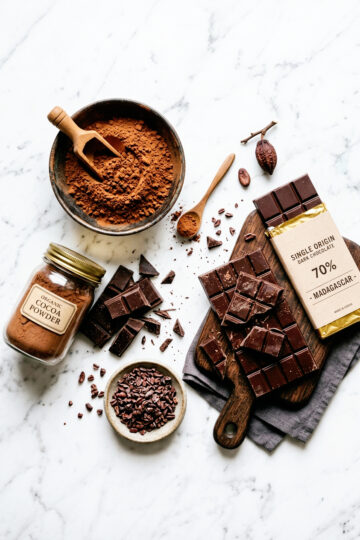
When a recipe calls for cocoa, always use unsweetened cocoa powder, unless specified otherwise.
This allows you to have better control of the sweetness of what you're making.
There are three basic forms of unsweetened cocoa powder: natural cocoa powder, Dutch-processed cocoa powder, and raw cacao powder.
Natural cocoa powder is your basic non-specialty cocoa powder, and it's the one you should use natural unsweetened cocoa powder for this recipe.
Natural cocoa powder is the most commonly used type of cocoa powder and is what you should use in most recipes, such as brownies, chocolate cupcakes, hot chocolate, or any recipe that simply says "cocoa powder."
Pro Tip: I store cocoa powder in a large canister so it doesn't make a mess when I go to use it. Doing this has made baking with cocoa so much easier and way less messy!
And, if you want to learn how to always use cocoa rather than melted chocolate in baking, you may like my post on how to substitute chocolate with cocoa powder.
Can I Use Dutch-Processed Cocoa Powder?
Dutch-processed cocoa powder starts with cocoa beans that have been treated with potassium carbonate, which neutralizes their acidity.
Since Dutch-processed cocoa powder is not acidic, it does not react with baking soda the way natural cocoa powder does.
Recipes that rely on natural cocoa powder for the acidity to trigger the baking soda may not rise properly if you replace the natural cocoa with Dutch-processed cocoa.
For this recipe, I recommend sticking with natural cocoa powder, though I have had readers who switched it out and liked the results. So if you want to try it, that's totally up to you.
Can I Use Raw Cacao Powder?
Raw cacao powder is different from natural and Dutch-processed cocoa powders.
It's made from the cacao bean and isn't nearly as processed. It comes from seeds that have been fermented and are processed at low temperatures to ensure that their nutritional benefits and bitter flavor are preserved.
You can use raw cacao powder if you really want to, but I don't recommend it, since it's not as absorbent as cocoa powder, and it may cause the recipe to be too liquidy and not bake properly.
Can I Use Sweetened Cocoa?
Sweetened cocoa is natural cocoa powder mixed with sugar.
Please don't use it when making this recipe because it will make it too sweet.
Do Eggs Need to Be at Room Temperature?
The short answer is "no."
While a lot of recipes call for room-temperature eggs, the difference is only noticeable if you do a side-by-side comparison, and even then, the difference is very slight.
How Can I Tell if My Eggs Are Still Good?
Fill a glass with cool water and submerge the eggs.
If the eggs sink to the bottom and lay flat on their side, they're still fresh.
If they sink but stand on one end at the bottom of the glass, the eggs are older but still good to use.
If an egg floats to the top, it's very old and should be checked carefully for signs of spoilage before using.
Can I Make This Without Using Eggs?
Yes. All you have to do is use 2 tablespoons of water in place of each egg.
Or, make my eggless chocolate cookies and replace the chocolate chips with walnuts.
How Do I Replace Eggs in Recipes?
After being asked by a mother how she could make one of my dairy free recipes for her child who is allergic to eggs, I did a lot of research into it and started making egg free recipes too. I'm here to help you know 🙂
So, if you want to make pretty much any recipe eggless, here's how you do it:
Eggs do three things in most recipes: they help bind the ingredients together, help them rise, and add moisture.
For example, eggs are the primary binder in a pumpkin pie, creating a sliceable custard, but in my chewy brownies they mostly just help them rise.
So, to replace eggs in fluffy things like eggless chocolate cakes and eggless cornbread, use ¼ cup of water per egg called for.
For cookies like my eggless chocolate chip cookies, use 2 tablespoons of water in place of each egg.
In pies like eggless pumpkin pie or in recipes like eggless meatloaf, and really anything that uses eggs as a binder, use 1 tablespoon of cornstarch and ⅓ cup of water per egg. Though don't try this with matzo balls, because it doesn't work-believe me, I've tested it and ended up with a big mess.
What kind of sugar should I use?
You should use white granulated sugar, which is also called white sugar, granulated sugar, and table sugar.
If you live in the United Kingdom, you can use caster sugar instead.
You should not use powdered sugar, which is mostly used for dusting desserts and making frosting, icing, and glazes. But it is sometimes used to make fudge.
an I use honey instead of sugar?
If you'd prefer to use honey instead of sugar, like I do in my honey challah recipe, you can. However, it may change the taste and texture somewhat.
Honey is sweeter than sugar, so you don't need as much of it. As a general rule, use ¾ cup of honey for every 1 cup of sugar.
- 1 cup sugar → ¾ cup honey
- ¾ cup sugar → ⅔ cup honey
- ⅔ cup sugar → ½ cup honey
- ½ cup sugar → 6 tablespoons honey
- ⅓ cup sugar → ¼ cup honey
- ¼ cup sugar → 3 tablespoons honey
Honey also adds liquid to the recipe, so you'll need to reduce the other liquid. For every cup of sugar you replace with honey, reduce the other liquid by about 3 to 4 tablespoons.
- 1 cup honey → remove 3 to 4 tablespoons liquid
- ¾ cup honey → remove about 2¼ to 3 tablespoons liquid
- ½ cup honey → remove about 1½ to 2 tablespoons liquid
- ¼ cup honey → remove about 1 tablespoon liquid
If there isn't enough liquid in the recipe to remove, you can remove it from the egg whites instead, but NEVER remove it from the oil.
Honey also causes baked goods to brown more quickly. For this reason, avoid using honey in recipes that need to be baked at temperatures above 350°F or 175°C.
What kind of brown sugar should I use?
You should use light brown sugar.
When a recipe calls for "brown sugar" without specifying whether it should be light or dark, it is referring to light brown sugar.
Can I substitute light brown sugar for dark brown sugar?
You can use dark brown sugar instead of light brown sugar in most recipes, but it will change the flavor somewhat.
Instead, I'd recommend combining equal parts dark brown sugar and white granulated sugar.
For example, use ½ cup of white granulated sugar and ½ cup of dark brown sugar to replace 1 cup of light brown sugar.
Can I make brown sugar at home?
Yes.
Brown sugar is white granulated sugar with molasses added to it, and light and dark brown sugar differ in the amount of molasses they contain, so it's actually easy to make brown sugar at home.
To make light brown sugar, combine 1 cup of white granulated sugar with 1 tablespoon of molasses.
For dark brown sugar, use 2 tablespoons of molasses instead. Add the sugar and molasses to a bowl and mix with a fork until completely combined.
You can also make dark brown sugar from light brown sugar by combining 1 cup of light brown sugar with 1 tablespoon of molasses and mixing until completely combined.
Can I use raw sugar or demerara instead of brown sugar?
Demerara sugar and raw sugar are not the same as brown sugar, but you can use them instead of brown sugar if you need to.
What Kind of Vanilla Should I Use?
There are several types of vanilla you can use in baking, including vanilla extract, imitation vanilla, vanilla paste, and vanilla beans.
For everyday baked goods like muffins, cakes, cookies, and quick breads, some options are more practical than others.
Vanilla Extract
Vanilla extract is made by soaking vanilla beans in alcohol, which extracts the compounds responsible for their flavor. It is the most common type of vanilla used in baking.
When a recipe-including mine-calls for vanilla extract or simply says "vanilla," this is the type of vanilla that is generally being referred to.
Can I use imitation vanilla?
Imitation vanilla, also called artificial vanilla or vanilla essence, is considerably less expensive than pure vanilla extract and works well in everyday baked goods.
Since vanilla extract can be expensive, you can use imitation vanilla in my recipes without a problem.
Imitation vanilla can be used spoon for spoon in place of pure vanilla extract.
Though, keep in mind that some imitation vanillas are better than others, so if you can, try to use a good one.
Can I use vanilla paste?
Vanilla paste is a thick mixture containing vanilla bean seeds and vanilla extract. Commercial vanilla pastes may also contain sweeteners, thickeners, or other ingredients.
It can generally be used in place of vanilla extract and leaves visible flecks of vanilla bean in your baked goods.
Vanilla paste can generally be substituted for vanilla extract spoon for spoon.
Can I use vanilla beans?
Vanilla beans are the pods of vanilla orchids. The seeds inside the pod can be scraped out and added directly to a recipe.
Vanilla beans are more expensive and less convenient than extract, so I wouldn't recommend them for everyday baking.
But if you want to, you can use about 1 teaspoon of vanilla extract for each inch of vanilla bean called for in a recipe.
This is only an approximation, since vanilla beans vary in size and strength.
Can I use vanilla sugar?
Vanilla sugar is sugar that has been flavored with vanilla. It is particularly common in Europe and parts of the Middle East, including Israel.
It can be made by storing vanilla beans in sugar, mixing vanilla bean powder with sugar, or combining sugar with vanilla extract. Some countries also sell vanilla powdered sugar for use in confections.
You can substitute vanilla extract with vanilla sugar spoon for spoon.
How Should I Store Vanilla?
Keep vanilla extract and other vanilla products away from heat and direct light. Store them in an airtight container in a cool, dark place.
Can I use baking soda and baking powder interchangeably?
No. Even though baking soda and baking powder are both leavening agents that make things rise, they work differently and aren't generally interchangeable.
When baking soda (also known as sodium bicarbonate) is combined with acidic ingredients, it makes carbon dioxide. This helps batter or dough rise and gives baked goods a light, fluffy texture.
That's why baking soda is commonly used in recipes have acidic ingredients, like buttermilk, lemon juice, vinegar, or natural cocoa powder.
Baking soda is also roughly four times as powerful as baking powder, so you don't need a lot of it. Using too much can actually give your baked goods a bitter or metallic taste.
Baking soda needs enough acid to react with it, so substituting it for baking powder can leave things flat and tasting off.
Baking powder, on the other hand, is a combination of both baking soda and an acid, so it doesn't need an acidic ingredient in the recipe to create carbon dioxide.
This makes baking powder useful in recipes that don't have enough acidic ingredients to activate baking soda. For example, it's commonly used in recipes like matzo balls and biscuits.
Because baking powder is less powerful than baking soda, recipes generally call for more of it. So, if you try to use baking soda instead of baking powder, the texture won't come out right and the flavor will probably taste disgusting.
Why do some recipes call for both?
Some recipes use both baking soda and baking powder because they do slightly different things.
For example, my chocolate cake has enough acid for baking soda to react with it, but if you'd use enough baking soda to give the cake the lift it need, it would ruin the flavor and you'd have to throw the cake out.
So, instead of adding more baking soda, the recipe uses baking powder to give additional rise.
How can I tell if baking soda and baking powder are still good?
Both baking powder and baking soda can continue to be used well past their best by dates, but they become less potent over time and can eventually stop working altogether.
To test baking soda, pour 3 tablespoons of white distilled vinegar into a small bowl, add ½ teaspoon of baking soda, and stir. The mixture should rapidly bubble if the baking soda is still active.
To test baking powder, pour 3 tablespoons of warm water into a small bowl, add ½ teaspoon of baking powder, and stir. If the baking powder is still active, it should fizz.
troubleshooting
While these cookies are very easy to make, ovens can make a big difference in the outcome.
why is it taking longer than described to bake?
Over time, the thermostat on ovens gets a little off, causing some ovens to run hot and others to run cool. This is why recipes tend to say things like "10 to 15 minutes or until golden brown."
So, if it takes you longer than expected, that's fine, don't worry about it. Just keep baking until ready.
why did my cookies come out dry?
Just like some ovens run cool, others run hot. If your oven runs hot, bake these at a lower temperature.
Ideally, you should get an oven thermometer to know what temperature you're really baking at.
Why did my cookies burn?
If you baked them for the right amount of time, then burning is usually caused by two reasons.
The first is if you put them on the lower shelf in the oven.
The second is if the bottom of your oven has food particles that dripped on to it. Even a small bit of food that drips down could cause an oven to have problems heating properly and burn the cookies.
how to store
Let cookies cool completely. Place in a resealable bag or an airtight container. Store at room temperature for up to a week.
how to freeze
Let cookies cool completely. It is best to freeze cookies on a tray so that they freeze as individuals. Then, move to a resealable freezer bag.
If this is not practical for you, place cooled cookies in a resealable freezer bag and freeze that way.
Cookies will keep for up to 3 months. After that, the quality begins to degrade.
When thawing baked cookies, remove from bag and let sit at room temperature.
If desired, you can gently reheat thawed cookies to mimic that fresh-baked taste and texture: place them in a 275°F or 135°C oven until soft.
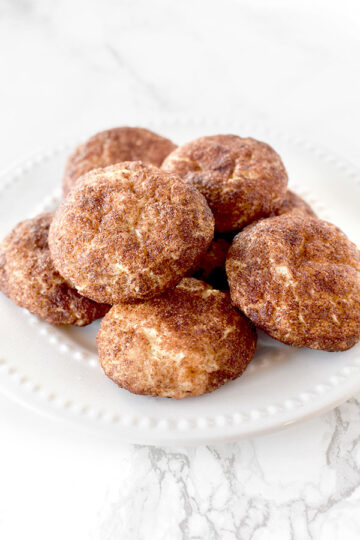
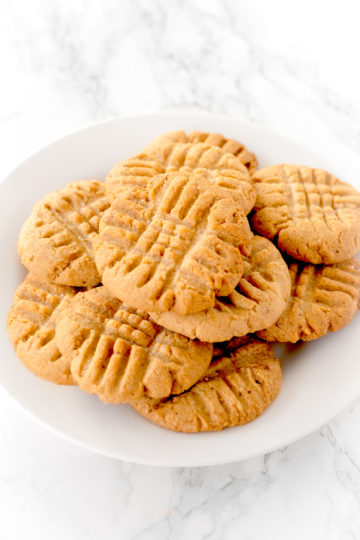
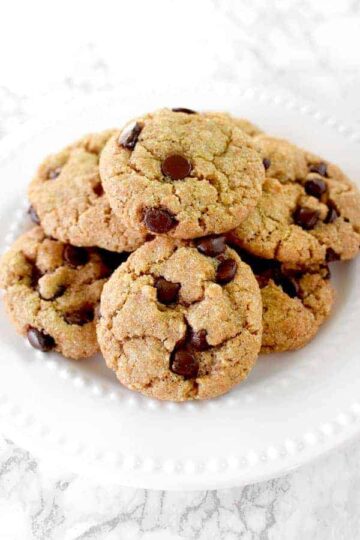
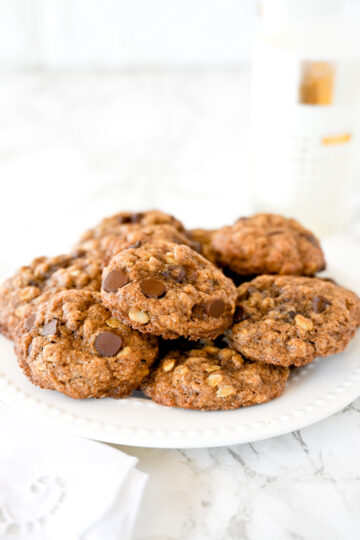
Other dairy free cookies you make like:
Chocolate Walnut Cookies
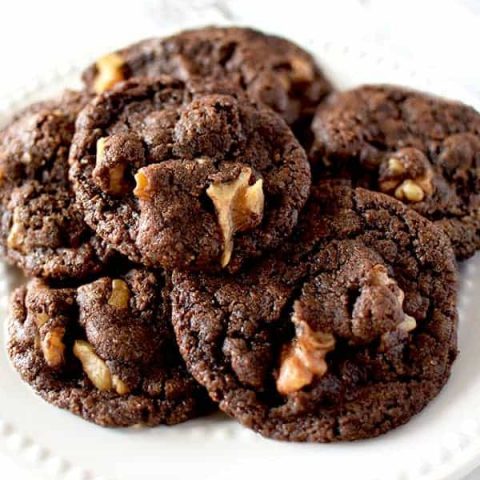
Few flavors go to together better than walnuts and chocolate, which makes this cookie an incredible one.
Ingredients
- 2 cups all-purpose flour (255 grams)
- ¾ cup white sugar (150 grams)
- ¾ cup brown sugar, packed (165 grams)
- ⅔ cup cocoa powder (70 grams)
- 1 teaspoon baking soda
- ¼ teaspoon salt
- 2 eggs, room temperature
- ¾ cup oil (175 milliliters)
- 2 tablespoons water
- 1 tablespoon vanilla
- 1 cups walnuts, chopped (125 grams)
Instructions
- Whisk together flour, both white and brown sugar, cocoa, baking soda, and salt in a mixing bowl.
- Add eggs, oil, water, vanilla extract, and chopped walnuts. Mix well.
- Preheat oven to 350°F or 175°C.
- Take about a tablespoon of dough, roll into a ball, and place on a baking sheet lined with parchment paper. Repeat until dough is finished. Bake for 8 to 10 minutes.
- Remove and let cool for 5 minutes before moving to a cooling rack.
Recommended Products
Some of the links below are affiliate links, which means that if you choose to make a purchase, I will earn a small commission. This commission comes at no additional cost to you.
Nutrition Information:
Yield:
40Serving Size:
1Amount Per Serving: Calories: 117Total Fat: 7gSaturated Fat: 1gTrans Fat: 0gUnsaturated Fat: 6gCholesterol: 9mgSodium: 49mgCarbohydrates: 13gFiber: 1gSugar: 7gProtein: 2g
The recipe was very easy, and we followed it exactly. The dough was very dry and crumbly but did press together into a ball. The first batch I let go longer than 10 minutes because the cookies were so soft - they were great once they cooled. The second batch went for just 11 minutes and they're pretty soft still, even having cooled. The dough and the cookie taste exactly like each other and are both very tasty. I prefer the longer-cooked ones, which are chewier and don't crumble so easily.
I'm glad you enjoyed the recipe 🙂