
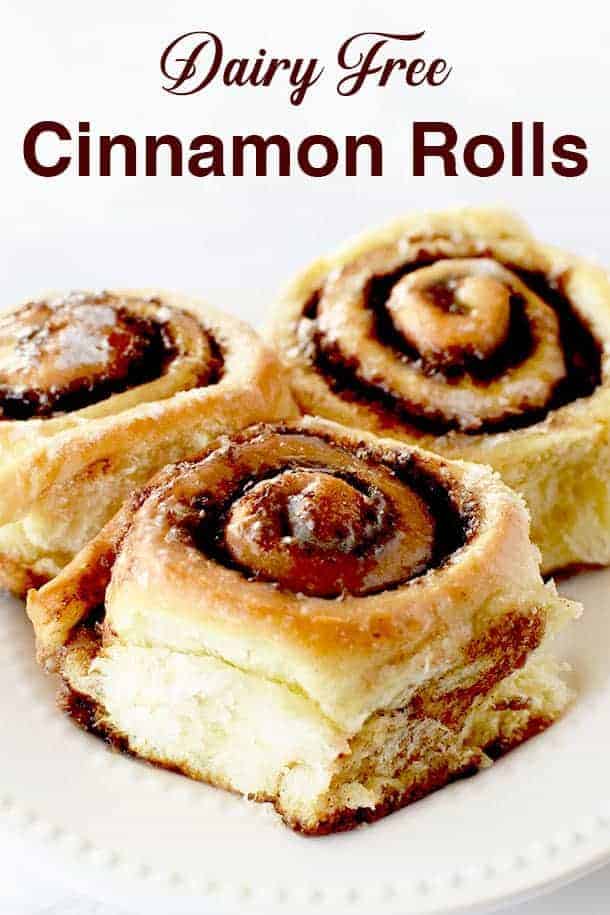
These dairy free cinnamon rolls made without milk and butter and with water and oil instead. They are so sweet and cinnamony and you'll be hard pressed to tell that they are dairy free.
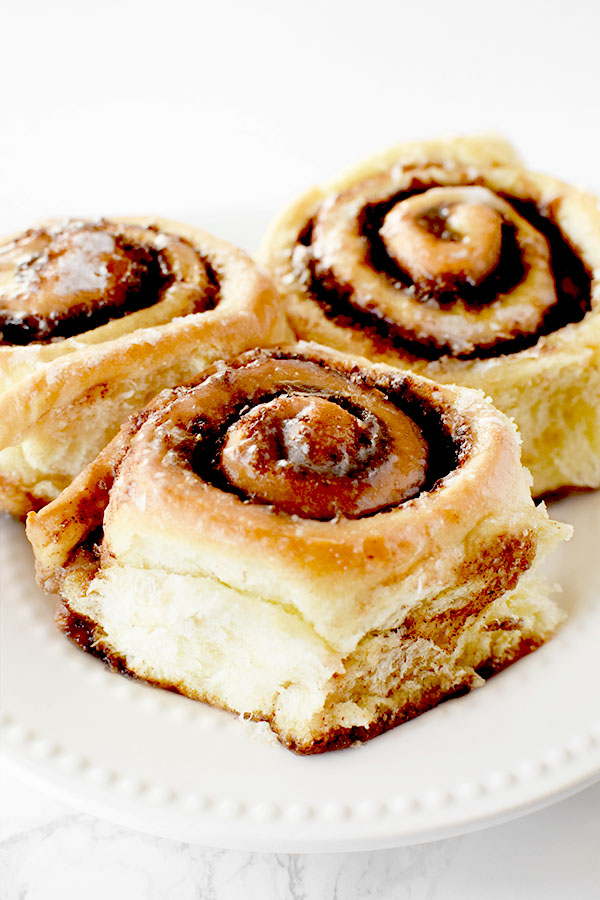
Also, unlike most cinnamon rolls, these dairy free cinnamon rolls are incredibly light and fluffy. Serve them as a dessert or just treat yourself to one any time of day!
Living in Israel, I'm surrounded by an amazing food culture with wonderful rich foods and pastries, but there are foods that I grew up with that I often miss.
One of the things my brother Ari missed most was cinnamon rolls. So, I decided to make them for him.
Ari couldn't get enough and gave them a ten out of ten.
Ever since then, for years now, these cinnamon rolls have been a staple in my families house.
⭐⭐⭐⭐⭐
"These are delicious! So thankful for dairy free cinnamon rolls! My son and husband loved them! Even did the first rise overnight like you shared in the comments! Your recipes are amazing! Thank you!"
Taryn
Jump to:
- How to Measure Flour and Other Dry Ingredients
- Would bread flour make it even better?
- Can I use whole wheat flour instead?
- Why do you use instant yeast?
- Why Does This Recipe Use Oil?
- Do Eggs Need to Be at Room Temperature?
- Can I Make it Without Using Eggs?
- What kind of sugar should I use?
- What kind of brown sugar should I use?
- how can i make my bread rise faster?
- Baking with Humidity
- Adjusting for a Convection Oven
- can i halve this recipe?
- troubleshooting
- how to make ahead
- how to store
- How to freeze
- MY SNAFU:
- Recipe Tips
- Other recipes you may like:
- Dairy Free Cinnamon Rolls
How to Measure Flour and Other Dry Ingredients
The best way to measure dry ingredients is with a scale, but in the United States, dry measuring cups are usually used instead.
Weighing ingredients is useful for home bakers, but it's especially important for professional bakers because they work with huge batches.
I usually use dry measuring cups when baking too, because I didn't grow up in a country that generally weighs ingredients, so please don't feel like you can't use them.
To measure most dry ingredients, first spoon them into a dry measuring cup and then level off the measuring cup with an upside-down butter knife.
Make sure not to pack it down because this will cause you to use more of the ingredient than the recipe calls for.
Brown sugar is the exception to the rule, though. To measure brown sugar, pack it into the measuring cup and then level off any excess.
To measure chocolate chips, nuts, or dried fruit, just pour them into the dry measuring cup and then level them off.
What are dry measuring cups?
Dry measuring cups are the set of cups that usually come with measuring spoons. Each cup is a different measurement, just like each spoon is a different measurement.
Liquid measuring cups, on the other hand, are the cups that usually hold more than one cup and have lines on the side that mark the measurements.
The problem with using liquid measuring cups to measure powdery dry ingredients, like flour and cocoa, is that you shake the cup to level them off. This causes the powder to settle, and you end up with more than you need.
I tested this with a friend who didn't believe me, and we ended up with a quarter cup more flour than the recipe called for.
Should I sift the flour and other dry ingredients?
It's usually recommended to sift your powdery ingredients, like flour and cocoa, before using them.
Sifting aerates the flour and removes any lumps, which helps make baked goods fluffier.
It also helps you get a more accurate measurement than when you use flour that's been packed tightly in a bag.
And sifting dry ingredients together, like flour, cocoa, and baking powder, helps make sure they're evenly distributed in the batter. Which honestly, I think is probably overrated, so I personally never bother with it.
Would bread flour make it even better?
No. Bread flour creates a chewy texture and heavier and denser bread like in bagels.
This can be great in recipes like bread bowls, but you want cinnamon rolls to be light and fluffy like challah bread, so stick with all purpose flour.
Can I use whole wheat flour instead?
I wouldn't recommend it. It will change the flavor of the cinnamon rolls - and in my opinion, not for the better.
Just let the cinnamon rolls be the decadent treat that they are.
Why do you use instant yeast?
I like instant yeast because it's really easy to use, it rises quickly, it doesn't come prepackaged into packets that don't match the amounts called for in the recipes, and it's more cost-effective than active dry yeast.
This is my favorite type of yeast to use because it lasts longer than fresh yeast, and you need less of it than active dry yeast. I use it whenever I make dinner rolls or cinnamon rolls.
Can I use active dry yeast?
Yes. You can replace instant yeast with dry yeast at a 1:1 ratio (which means spoon for spoon or the exact same amount).
But, keep in mind, it could take 15 to 20 minutes for the dough to rise to double in size.
And, keep in mind, if your yeast is older than 2015 (which is possible because it lasts ages when you freeze it and if you use it sparingly), you need to activate it before using it.
Around 2015, active dry yeast was reformulated so that you wouldn't need to activate it anymore, so you almost definitely do not need to activate/bloom it first, but double-check the instructions on the package just in case.
Can I use rapid-rise yeast?
Rapid-rise yeast is often specifically marketed toward users of bread machines. It's pretty much just instant yeast with a smaller grain.
The smaller granules allow it to dissolve faster in the dough, allowing it to rise even faster than instant yeast, so keep an eye on it to make sure it doesn't overproof.
Can I use fresh yeast?
Fresh yeast, cake yeast, block yeast, wet yeast, or compressed yeast is found in small, foil-wrapped cubes.
It is far less popular with home bakers because it's highly perishable. However, it is still widely available for commercial use and is still used by home bakers in some countries.
The benefit of using it is that it's easier to measure and has the most leavening power.
If you want to use fresh yeast in this recipe, then for every 1 teaspoon of instant dry yeast, you'd need 17 grams (or 0.6 ounces) of fresh yeast.
Make sure to bloom/activate the yeast before using it in this recipe.
Can I use sourdough starter instead of yeast?
Sourdough starter is wild yeast (which exists in the air) that has been cultivated.
I haven't tested it, so I really wouldn't recommend it. Sourdough is much more finicky to work with.
My brother once made a starter and named it Meekol (as if my family didn't have enough pets between the dog, backyard cats, parrots, and hamsters, we now had a pet made of fermented cultures!).
It was easy enough to make, but when we tried to make sourdough bread from some of it, it totally flopped, and the sourdough bread (if the results could even be called that) was thrown out.
In my opinion it's really too risky to use for this recipe.
Why activate the yeast first?
Even though I use instant yeast, I recommend activating it first if you have concern that it may be old.
This is especially important if you store your yeast outside the freezer, which drastically shortens its life span.
I almost always activate my yeast first, even though I store it in the freezer, because it helps me troubleshoot if something goes wrong.
I've had it happen a few times that the dough in a recipe took a long time to rise, and I was scared that the yeast wasn't good anymore, and I wasn't sure if the dough was hopeless and I should throw it out and start over (if I even had the time to start over), or if I should give it more time.
It always turned out that it just needed more time, but that caused me enough stress that I almost always make sure to proof the dough first just to be sure the yeast is still alive.
And it's particularly useful when you don't have a "warm" place to let it rise, because lower temperatures cause the dough to rise slowly.
And of course, if you're using fresh yeast, you do have to activate it first.
How do I activate yeast?
To activate or bloom the yeast, mix the yeast with warm liquid (usually around 110°F or 43°C) with sugar.
Most recipes call for a small amount of sugar, but I always use all of the sugar and liquid called for in the recipe to save time.
The sugar provides a food source for the yeast. After a few minutes, the mixture should become frothy, telling you that the yeast is active and ready for use.
Sometimes it could take longer, so don't worry if it takes around 10 minutes to be sure.
After that, you can add the rest of the ingredients to make the dough.
Why Does This Recipe Use Oil?
Cakes, cupcakes, muffins, and quick breads made with oil usually bake up taller, have a better crumb, and a lighter texture than ones made with butter.
They also tend to stay moist and tender longer.
In fact, some recipes call for both oil and butter, instead of only butter, if they want a lighter and airier texture while still keeping the butter flavor.
I created a baking with oil - butter to oil conversion chart for you in case you want to convert some of your butter recipes to oil recipes.
Which Type Of Oil to Use
I don't specify in the recipe which type of oil to use because it's mostly personal preference and I don't want anyone to feel they have to use specifically that type of oil. For the most part, you can use whatever oil you feel most comfortable using.
I use neutral oils like canola oil, safflower oil, and vegetable oil.
You can also use stronger oils like olive oil and coconut oil, but keep in mind that they may change the taste somewhat.
If you're going to use olive oil, use the one labeled pure olive oil because it has the mildest flavor. This should make the flavor a lot less noticeable.
Is It Better to Use Canola Oil or Olive Oil?
Canola oil is relatively cheap and, due to its lack of flavor and high smoke point, is very versatile.
Olive oil, on the other hand, is generally considered a healthier choice.
So, really, it's whatever you prefer.
Do Eggs Need to Be at Room Temperature?
The short answer is "no."
While a lot of recipes call for room-temperature eggs, the difference is only noticeable if you do a side-by-side comparison, and even then, the difference is very slight.
Are Eggs Dairy?
No, eggs are not dairy.
Dairy is milk and any food products made from milk, including cheese, cream, butter, and yogurt.
So, while eggs are an animal product, they are not dairy.
Recipes like scrambled eggs made without milk are dairy free even though they contain eggs, since they do not use milk or butter.
If this sounds like a silly question to you, you'd be surprised how many people think eggs are dairy because they're in the refrigerated section of the supermarket.
How Can I Tell if My Eggs Are Still Good?
Fill a glass with cool water and submerge the eggs.
If the eggs sink to the bottom and lay flat on their side, they're still fresh.
If they sink but stand on one end at the bottom of the glass, the eggs are older but still good to use.
If an egg floats to the top, it's very old and should be checked carefully for signs of spoilage before using.
Can I Make it Without Using Eggs?
Yes. I recommend you try my Eggless cinnamon rolls instead.
How Do I Replace Eggs in Recipes?
After being asked by a mother how she could make one of my dairy free recipes for her child who is allergic to eggs, I did a lot of research into it and started making egg free recipes too. I'm here to help you know 🙂
So, if you want to make pretty much any recipe eggless, here's how you do it:
Eggs do three things in most recipes: they help bind the ingredients together, help them rise, and add moisture.
For example, eggs are the primary binder in a pumpkin pie, creating a sliceable custard, but in my chewy brownies they mostly just help them rise.
So, to replace eggs in fluffy things like eggless chocolate cakes and eggless cornbread, use ¼ cup of water per egg called for.
For cookies like my eggless chocolate chip cookies, use 2 tablespoons of water in place of each egg.
In pies like eggless pumpkin pie or in recipes like eggless meatloaf, and really anything that uses eggs as a binder, use 1 tablespoon of cornstarch and ⅓ cup of water per egg. Though don't try this with matzo balls, because it doesn't work-believe me, I've tested it and ended up with a big mess.
What kind of sugar should I use?
You should use white granulated sugar, which is also called white sugar, granulated sugar, and table sugar.
If you live in the United Kingdom, you can use caster sugar instead.
You should not use powdered sugar, which is mostly used for dusting desserts and making frosting, icing, and glazes. But it is sometimes used to make fudge.
What kind of brown sugar should I use?
You should use light brown sugar.
When a recipe calls for "brown sugar" without specifying whether it should be light or dark, it is referring to light brown sugar.
Can I substitute light brown sugar for dark brown sugar?
You can use dark brown sugar instead of light brown sugar in most recipes, but it will change the flavor somewhat.
Instead, I'd recommend combining equal parts dark brown sugar and white granulated sugar.
For example, use ½ cup of white granulated sugar and ½ cup of dark brown sugar to replace 1 cup of light brown sugar.
Can I make brown sugar at home?
Yes.
Brown sugar is white granulated sugar with molasses added to it, and light and dark brown sugar differ in the amount of molasses they contain, so it's actually easy to make brown sugar at home.
To make light brown sugar, combine 1 cup of white granulated sugar with 1 tablespoon of molasses.
For dark brown sugar, use 2 tablespoons of molasses instead. Add the sugar and molasses to a bowl and mix with a fork until completely combined.
You can also make dark brown sugar from light brown sugar by combining 1 cup of light brown sugar with 1 tablespoon of molasses and mixing until completely combined.
Can I use raw sugar or demerara instead of brown sugar?
Demerara sugar and raw sugar are not the same as brown sugar, but you can use them instead of brown sugar if you need to.
how can i make my bread rise faster?
To speed up the rising process, you can preheat the oven to its lowest temperature and turn it off.
Then, cover the dough with a damp towel and place it in the oven.
This trick works for me every time. On occasion, I may need to remove the dough and preheat the oven another time or two, but usually just once does the trick.
Some bakers feel it doesn't allow flavors to really develop. Personally, I've never noticed much of a difference.
how do you punch dough?
"Punching" is a bit of a strong word. Yeast is a delicate living thing, so you actually need to treat it with care.
What you're really doing is lightly pressing down the dough through the center with your fist. This removes gases that have formed during the first rise.
By doing this, you are also bringing the yeast, sugar, and moisture back together, which is important for the second rise as the yeast feeds on the sugar.
After you "punch" down the dough, you should pull the edges of the dough to the center. Then, take the dough out of the bowl and place it on a lightly floured board. Next, scrape out the remaining dough from the bowl using a rubber spatula.
Lastly, shape your dough into a ball, and if desired, you can knead the dough two or three times to release additional air bubbles.
I like kneading my dough a few times by hand after the mixer has done most of the work. This creates an extra smooth crust.
What is Overproofing Dough?
Letting the dough rise is known as "proofing the dough." Overproofing is when you let the dough rise too much.
If you let your dough rise too much, it will seem big and beautiful at first, and then it will fall and become dense after it's removed from the oven.
If you've found that you left the dough to rise to much larger than double its original size, punch it down, reshape it, and then let it rise to its proper size.
do you Really need a second rise?
The second rise allows the yeast to feed longer on the sugar. This allows the bread to become larger, have a better crumb, and develop a better flavor.
Also, if you were to let it rise only once, punch it down, shape it, and stick it in the oven, your bread would rise somewhat, but not enough for it to become fluffy.
Can i put the dough in the Fridge?
If you want to slow the rising process, you can refrigerate the dough.
You can refrigerate dough for up to 2-3 days. After that, the yeast may lose potency.
Keep in mind, the dough will continue to rise slowly during that time.
You may want to try my dairy free no knead cinnamon rolls.
Can I freeze unbaked dough for later use?
You can freeze dough in airtight freezer container for up to four weeks.
When you're ready to use it, first thaw the dough in the refrigerator overnight.
It will take up to twice as long for the dough to rise as it would if it hadn't been frozen.
Why did my dough turn out dense and heavy?
This can be due to overkneading, not letting it rise completely, overproofing, or using too much flour.
Baking with Humidity
Humidity can have a big impact on how your baked goods come out.
This is because when humidity is extremely high (think 70 percent or more), baking ingredients like flour, sugar, salt, baking powder, and baking soda soak up moisture from the air.
This can negatively impact the outcome of your cakes, cookies, yeast breads, and quick breads.
There are some things you can do to try to save your baking.
Try to counterbalance the additional moisture
To help counterbalance the additional moisture your dry ingredients soak up from the air, try reducing the amount of liquid in the recipe by about one quarter.
If the batter or dough looks too dry once all the ingredients are mixed together, add additional liquid a tablespoon at a time until you have the desired consistency.
This is not usually possible to do for cookies, but it does work for cakes and breads.
Store Ingredients in the Fridge
If flour and sugar are stored in the refrigerator or freezer rather than in a cupboard or pantry, they are better protected from humidity.
As an added benefit, keeping these ingredients cool also helps keep them fresher longer, in addition to helping them stay bug-free.
For the best results, let them warm to room temperature before using.
Bake for Longer
If you bake your goodies for a few extra minutes, it can help the liquid to cook off.
To avoid overbaking, continue testing for doneness every couple of minutes for breads, quick breads, cakes, cupcakes, and muffins. Cookies, on the other hand, need to be checked every minute.
Use Air Conditioning
To help lower humidity levels on humid summer days, air condition the room for at least an hour before you start baking.
Cooler air isn't able to hold as much moisture as warm air.
Store your baked goods in an airtight container
Humidity can also ruin your fresh-baked goods because when they are left out, they can absorb moisture.
To avoid this, store them in an airtight container or resealable bag.
Adjusting for a Convection Oven
When recipes specify temperatures and cooking times, it's for conventional ovens, unless specified otherwise.
Convection ovens blow the hot air around, producing around 25 to 30 percent more heat.
Since convection ovens produce more heat, you need either lowering the temperature or shortening the cooking time to compensate.
A simple rule to follow is to lower the temperature by 25ºF. Some convection ovens offer separate settings for baking and for roasting.
You can also leave the temperature the same and instead, shorten the cooking time by 25% percent.
However, keep in mind, some convection ovens actually make a heat adjustment for you. That is, if you set a convection oven for 350ºF, it might actually set itself to 325ºF to compensate. So, check your manual before making adjustments.
can i halve this recipe?
Yes, but if you do, use an 8-inch square baking pan instead.
troubleshooting
While this is a very reliable recipe, life happens and sometimes things don't go as planned.
why is it taking longer to bake?
Overtime, the thermostat on ovens gets a little off, causing some ovens to run hot and others to run cool.
This is why recipes tend to say things like "10 to 15 minutes or until golden brown."
So, if it takes you longer than expected that's fine, don't worry about it. Just keep baking until ready.
why did it Come out dry?
Just like some ovens run cool, others run hot. If your oven runs hot, bake these at a lower temperature. Ideally, you should get an oven thermometer to know what temperature you're really baking at.
how to make ahead
If you want, you can make the dough the night before and store it in the fridge so it rises very slowly overnight.
Then you can take the dough out the next morning and finish it as directed.
Make sure to cover the bowl well with plastic wrap so the air doesn't get to it and create hard crusty pieces in the dough.
how to store
Cover cinnamon rolls tightly with plastic wrap. This will preserve the cinnamon rolls for two days at room temperature.
To preserve them for up to a week: refrigerate the cinnamon rolls in a sealed plastic bag with as much air removed as possible.
How to freeze
To freeze, let glazed cinnamon rolls cool. store inside of a heavy-duty freezer bag and squeeze out the excess air before sealing.
They can freeze for up to 2 to 3 months. After that time, they will still be safe to eat but their quality will begin to degrade.
When ready, thaw in the refrigerator the night before you want to serve the rolls.
The next morning, preheat your oven to 325°F or 160°C and reheat them for 5 to 10 minutes or until warm. Glaze and serve.
MY SNAFU:
My only trouble with this recipe was the glaze.
First, I thinned it out too much, then I put it while the rolls were still hot so it kind of melted.
Both of these gave me a kind of doughnut glaze.
Then I tried to put in less water or dairy free milk, but that made it nearly impossible to mix.
In the end, I added a quarter teaspoon extra at a time until I got it just right.
I will say though, even too thin it tasted amazing!
Recipe Tips
- While I used a sharp chef's knife to cut the roll into slices, you can also use flavorless dental floss for easy cutting.
- If you don't want to take the time to chill the dough, lightly oil your rolling pin so the dough doesn't stick.
- For a thin glaze, add another spoon or two of water.
Other recipes you may like:
You may also like to try one of my many other dairy free desserts.
Dairy Free Cinnamon Rolls
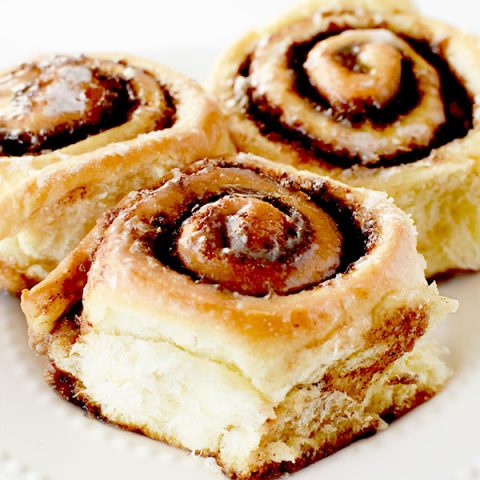
These cinnamon rolls are fluffy, moist, and delicious!
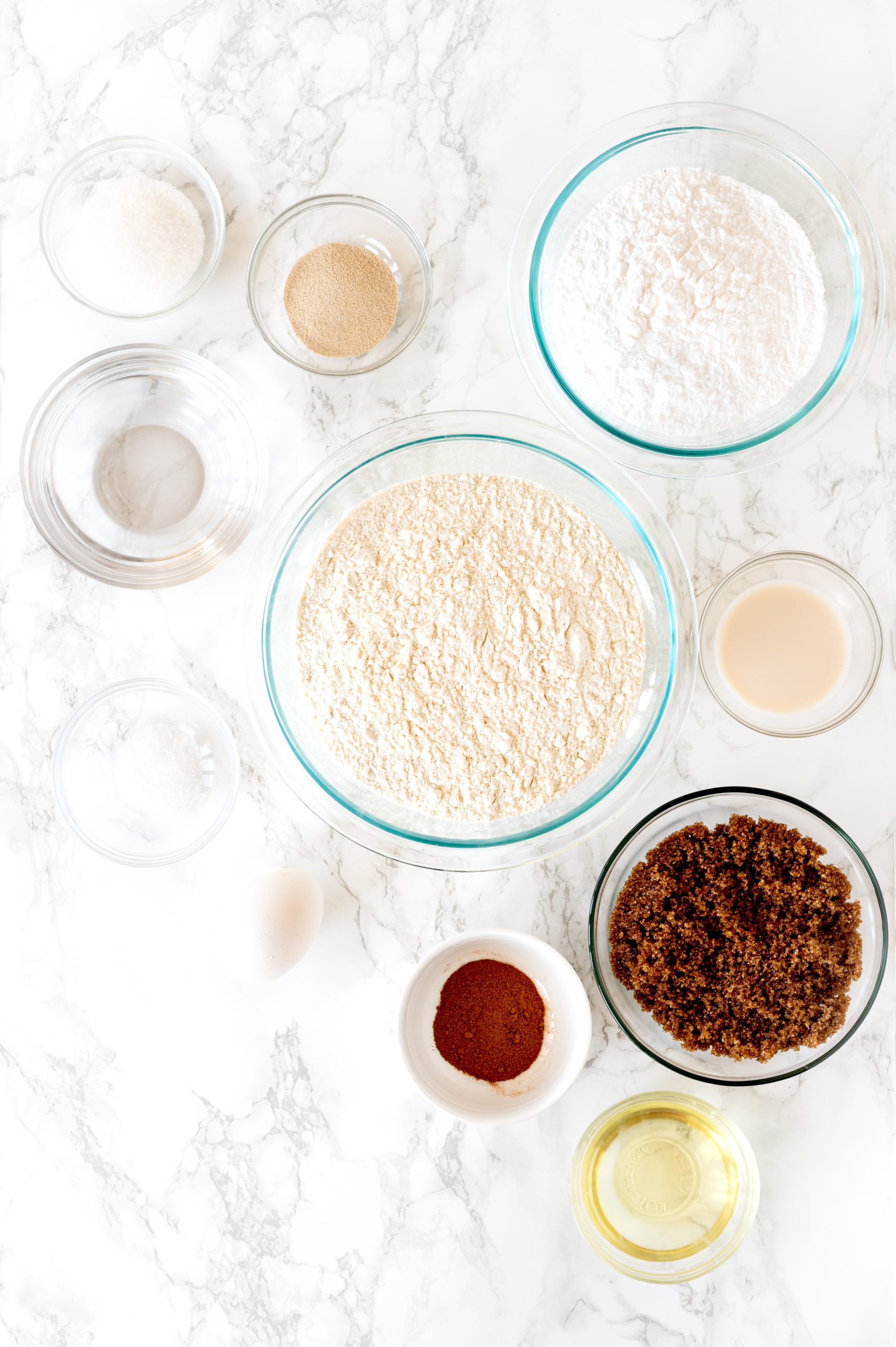
Ingredients
Dough
- 1 cup warm water (240 milliliters)
- 1 tablespoon instant yeast
- 2 tablespoons sugar
- 3 tablespoons oil
- 1 egg
- 1 teaspoon salt
- 3 cups all-purpose flour (360 grams)
Filling
- 1 cup brown sugar, packed (210 grams)
- 2 tablespoons cinnamon
- ¼ cup oil* (60 milliliters)
Glaze
- 1 ½ cups powdered sugar (180 grams)
- 3 tablespoons hot water or warm dairy free milk
Instructions
- Pour warm water, yeast, and sugar into the bowl of a stand mixer. Let sit for a few minutes until the yeast is activated and frothy.
- Add oil, egg, salt, and flour. Knead using the dough hook until the dough is smooth but sticky.
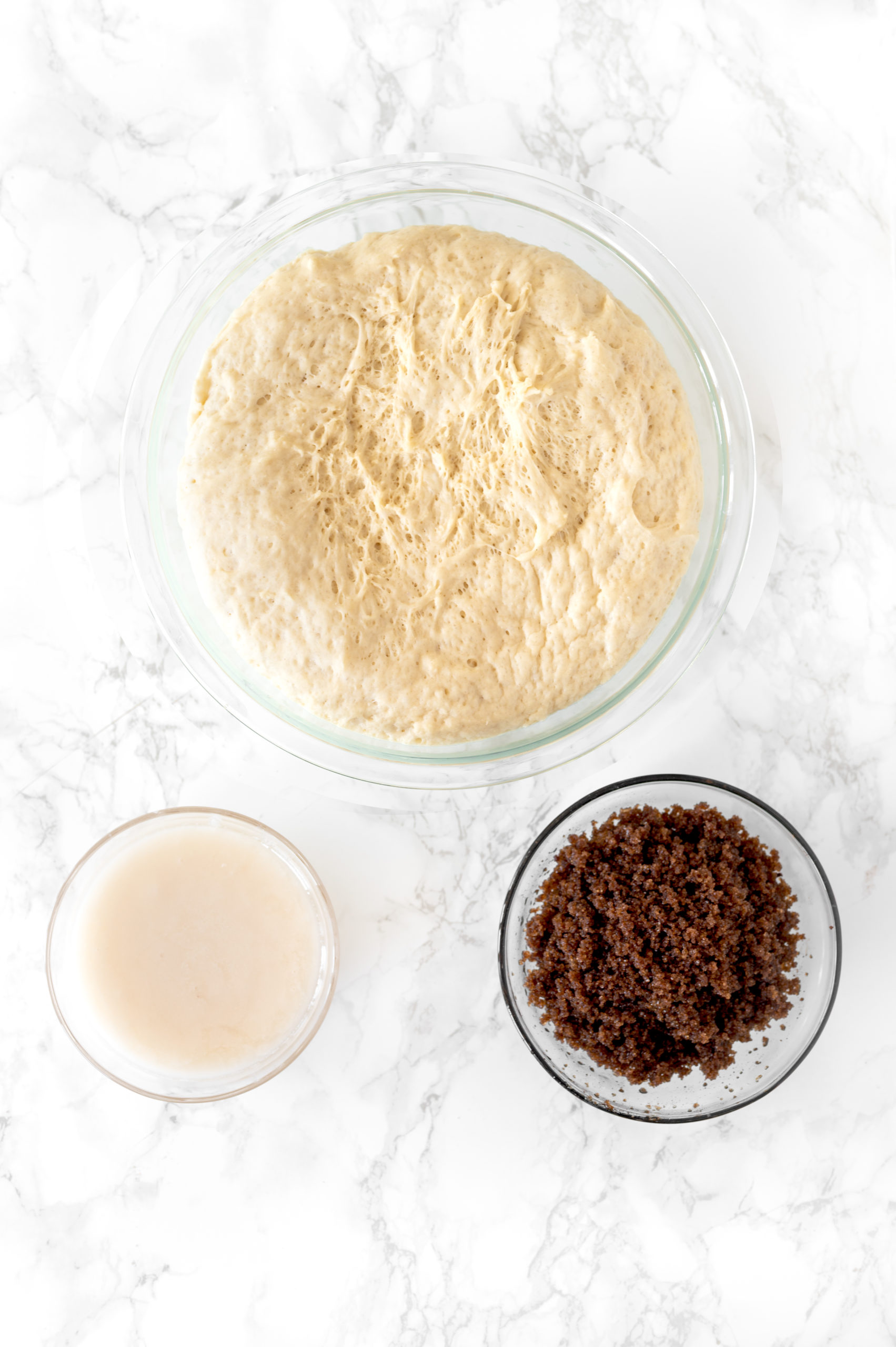
- Cover the bowl with a damp towel and put in a warm place. Let it rise until it's doubled in size.
- Optional: Chill for about half an hour, making it easier to roll out.
- Punch (press) the dough down. Then, remove and place it on a lightly floured surface and roll the dough out into a large rectangle.
- In a mixing bowl, combine brown sugar and cinnamon.
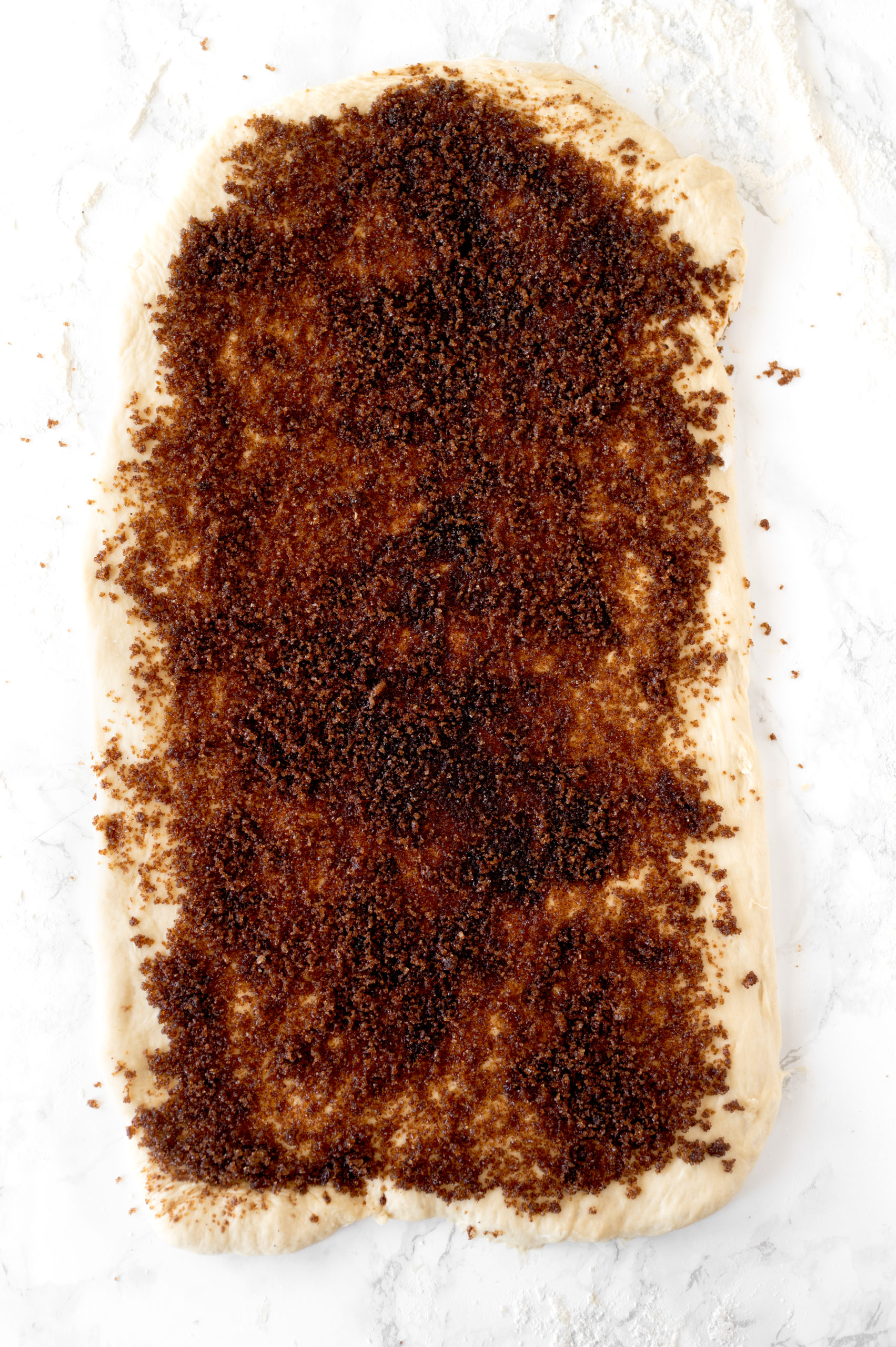
- Lightly pour the oil on the dough and brush it out. Then, sprinkle the cinnamon sugar mixture over it as evenly as possible.
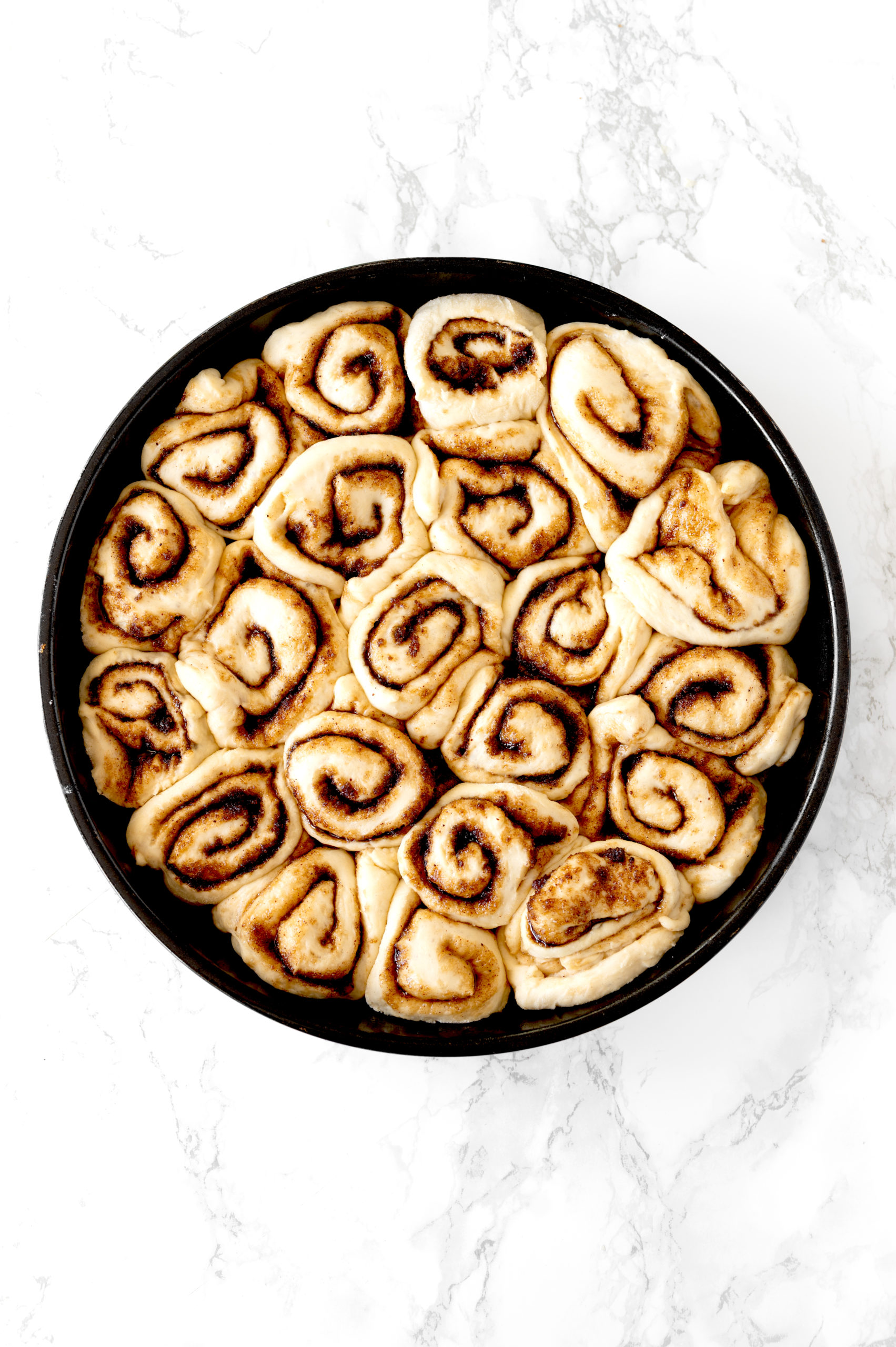
- From the longer side, roll the dough tightly. Then, cut the roll into 12 pieces and place the pieces in a parchment paper lined 9×13 baking pan.
- Cover with a damp towel and put in a warm place. Let it rise until it is about double in size.
- Preheat your oven to 350°F or 175°C. When it is fully heated, place the pan in the oven and bake for 20 minutes or until it begins to brown slightly. Remove the pan from the oven and let it cool.
- Combine the confectioners' sugar and water and mix until you have a nice, thick, smooth glaze. If it is too thick, add more water a ¼ teaspoon at a time until you achieve the desired consistency.
- When the cinnamon rolls are completely cool, spoon the glaze over the rolls. Best served at room temperature.
Notes
A great trick when working with dough is to put a little oil on your hands to prevent it from sticking.
Nutrition Information:
Yield:
12Serving Size:
1Amount Per Serving: Calories: 307Total Fat: 11gSaturated Fat: 1gTrans Fat: 0gUnsaturated Fat: 9gCholesterol: 17mgSodium: 206mgCarbohydrates: 48gFiber: 2gSugar: 22gProtein: 5g

Hi, I'm ElissaBeth!
I created The Taste of Kosher to give you delicious, easy-to-make recipes you can feel proud to serve. I don't believe there are bad cooks and bakers, only bad recipes. I also believe that kosher and allergy-friendly recipes can and should taste just as good as the originals, and it's my mission to prove it.
Can you double this recipe?
Yes, there shouldn't be any problems with doubling the recipe.
Cinnamon rolls turned out great- nice airy texture I was hoping for. Excellent recipe. I really appreciate your approach to dairy-free recipes. I didn't do the icing and they were still very satisfying. They generous amount of brown sugar made a nice sweet bottom. I did the first rise overnight in the fridge.
I'm so glad you enjoyed them! ❤️
How long does it usually take to double in size? An hour?
It depends on the temperature of the room you have it in. Often it's about 45 minutes to an hour.
Is it possible to substitute the egg with a flax egg?
I haven't personally tried it but I know that people do it so I don't see why it wouldn't work 🙂
Can I make these without a mixer?
Sure, you can kneed them by hand if you prefer