
These perfect matzo balls are simple to make and come out light and fluffy. They are everything one dreams of from "floater matzo balls" and more.
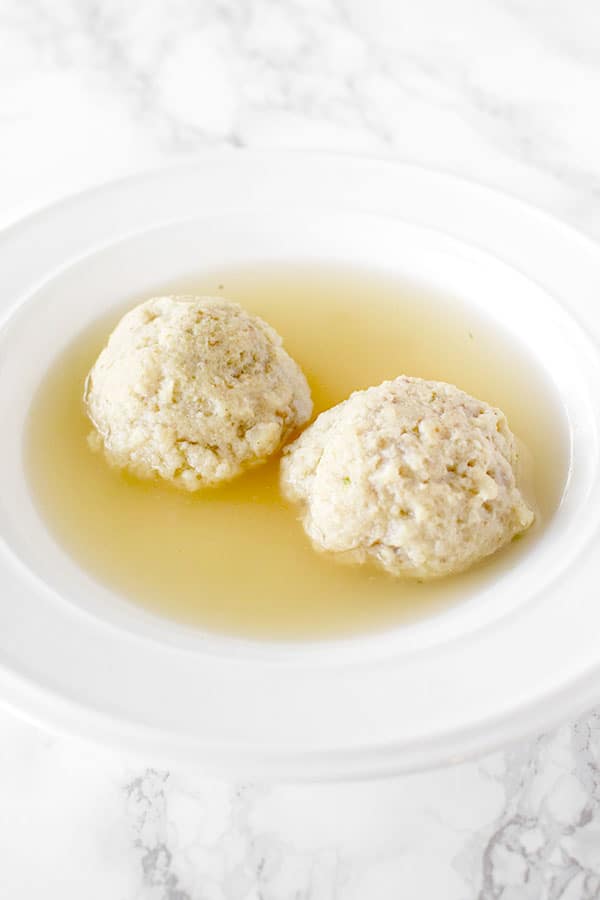
I don't think there is any more iconic Jewish or Passover (Pesach) food than matzo ball soup.
My whole family waits all year for it and have started making it on occasion when it isn't Pesach.
When my brother was spending his gap year in Israel, the hardest part for him was missing the matzo ball soup.
He even made my Mom promise she'd make it when he got back in the summer, and she did.
This was many years ago, but to this day it is still his favorite food.
In fact, since moving to Israel, our Mom now promises to make it for him when he comes to visit from the States where he chose to stay.
Since the rest of the family moved to Israel, my mom decided to start making matzo ball soup herself because she didn't like the prices on the packages.
We tried a number of popular recipes but none compared to the box stuff we used in the States.
So, after a while, I became determined to create the perfect recipe.
While these matzo balls are just like those in the box but made at home, you may also like my fluffy matzo balls.
Trail and Error
First, I raised the baking powder to one teaspoon. It wasn't much better than before.
Next, I tried ½ a teaspoon of baking soda. I did this because while every recipe I saw used baking powder, baking soda was listed in the ingredients on the box.
This gave me matzo balls that were fluffy on the outside and firm on the inside.
I liked them, but my goal was to get the fluffy box stuff so I kept on.
Finally, I tried 2 teaspoons of baking powder. These came out perfect!
However… they were a little boring since they didn't have any seasoning.
So, looking at the box again, I saw that it included onion powder and garlic powder.
This made all the difference.
can you use baking soda on passover?
Absolutely! As long as the box is marked kosher for Passover with a "P" next to the kosher symbol.
I get this question a lot because of the fact that it is a leavener.
The truth is though, while laws regarding Passover are complex, the focus is on wheat flour rather than the leavener itself.
In fact, there wasn't anything to leaven bread in ancient times except wild yeast.
So, the bread they were making was something of a sour dough bread.
This is the reason it took so long to rise.
Can I use baking soda and baking powder interchangeably?
No. Even though baking soda and baking powder are both leavening agents that make things rise, they work differently and aren't generally interchangeable.
When baking soda (also known as sodium bicarbonate) is combined with acidic ingredients, it makes carbon dioxide. This helps batter or dough rise and gives baked goods a light, fluffy texture.
That's why baking soda is commonly used in recipes have acidic ingredients, like buttermilk, lemon juice, vinegar, or natural cocoa powder.
Baking soda is also roughly four times as powerful as baking powder, so you don't need a lot of it. Using too much can actually give your baked goods a bitter or metallic taste.
Baking soda needs enough acid to react with it, so substituting it for baking powder can leave things flat and tasting off.
Baking powder, on the other hand, is a combination of both baking soda and an acid, so it doesn't need an acidic ingredient in the recipe to create carbon dioxide.
This makes baking powder useful in recipes that don't have enough acidic ingredients to activate baking soda. For example, it's commonly used in recipes like matzo balls and biscuits.
Because baking powder is less powerful than baking soda, recipes generally call for more of it. So, if you try to use baking soda instead of baking powder, the texture won't come out right and the flavor will probably taste disgusting.
Why do some recipes call for both?
Some recipes use both baking soda and baking powder because they do slightly different things.
For example, my chocolate cake has enough acid for baking soda to react with it, but if you'd use enough baking soda to give the cake the lift it need, it would ruin the flavor and you'd have to throw the cake out.
So, instead of adding more baking soda, the recipe uses baking powder to give additional rise.
How can I tell if baking soda and baking powder are still good?
Both baking powder and baking soda can continue to be used well past their best by dates, but they become less potent over time and can eventually stop working altogether.
To test baking soda, pour 3 tablespoons of white distilled vinegar into a small bowl, add ½ teaspoon of baking soda, and stir. The mixture should rapidly bubble if the baking soda is still active.
To test baking powder, pour 3 tablespoons of warm water into a small bowl, add ½ teaspoon of baking powder, and stir. If the baking powder is still active, it should fizz.
What is the difference between matzo balls and dumplings?
Matzo balls are a specific type of dumpling in that they are made using matzo meal.
The box doesn't have liquid in the recipe. Why does yours?
I tried making it without the liquid, but it came out way too dry.
I think it's because the box matzo mix meal is very fine whereas regular matzo meal is coarse.
My guess is, the fine matzo meal doesn't need as much liquid.
Schmaltz vs Oil
Schmaltz is the traditional fat used in matzo balls. However, in recent decades, oil has become at least as common.
While I usually use oil for convenience, many say that schmaltz elevates the flavor of the matzo ball.
Chilling
You can chill the matzo balls for anywhere between 15 minutes and overnight.
However, this will make your matzo balls firmer than they would be if you didn't chill them.
I don't chill mine because I like them fluffy on the outside and to have some substance on the inside but not firm.
Make Ahead
Matzo balls can be made ahead of time.
Just cook them, remove them from the liquid, and refrigerate them in a resealable plastic bag or airtight container.
Refrigerate for 3 to 5 days.
Freeze
You can freeze matzo balls on a tray and then move them to a resealable plastic bag or airtight container.
Freeze for up to 3 months.
After three months, they are still safe to eat, but their quality begins to degrade.
Other Passover Recipes You May like:
- Passover Macaroons
- Passover Potato Kugel
- Passover Brownies
- Passover Cheesecake
- Passover Pancakes
- Passover Chocolate Cake
- Kosher for Passover Mayonnaise
Perfect Matzo Balls
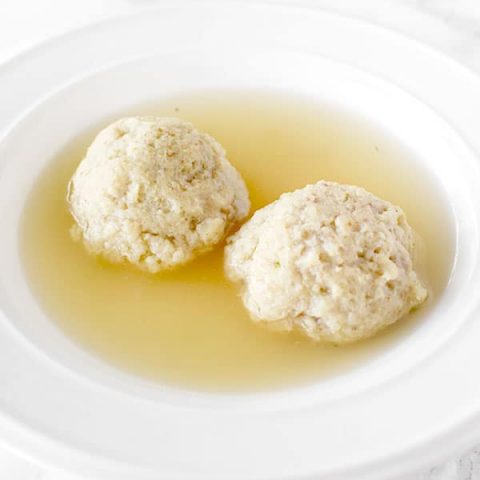
These matzo balls are perfectly light and fluffy, just like the stuff you get out of a box. Matzo balls really don't get better than this!
Ingredients
- 1 cup matzo meal (115 grams)
- 2 teaspoon baking powder
- ½ teaspoon salt
- ½ teaspoon garlic powder
- ½ teaspoon onion powder
- 4 large eggs
- ¼ cup oil or melted schmaltz (60 milliliters)
- ¼ cup water or stock (60 milliliters)
Instructions
- In a large mixing bowl, add matzo meal, baking powder, salt, garlic powder, and onion powder. Whisk to combine.
- Add eggs, water, and schmaltz or oil. Mix with a fork until combined.
- For firmer matzo balls, chill for 20 minutes or longer. For matzo balls that are fluffy on the outside but have substance on the inside, let them sit at room temperature.
- Fill a wide pot with water or stock and bring to a boil.
- With wet hands, take some of the mix and mold it into the size of a ping-pong ball. Gently drop it into the boiling water. Repeat until done.
- Reduce the heat to a simmer. Cook 20 minutes or until a toothpick goes smoothly through a little passed the center of the matzo balls. Do not stir the pot until the matzo balls are done cooking, or else they will fall apart.
Notes
If you don't want to chill the mix, you can let it sit out at room temperature. Letting the mix chill makes the mix less sticky.
Nutrition Information:
Yield:
15Serving Size:
1Amount Per Serving: Calories: 119Total Fat: 5gSaturated Fat: 1gTrans Fat: 0gUnsaturated Fat: 4gCholesterol: 50mgSodium: 178mgCarbohydrates: 14gFiber: 0gSugar: 0gProtein: 4g

Hi, I'm ElissaBeth!
I created The Taste of Kosher to give you delicious, easy-to-make recipes you can feel proud to serve. I don't believe there are bad cooks and bakers, only bad recipes. I also believe that kosher and allergy-friendly recipes can and should taste just as good as the originals, and it's my mission to prove it.
Pro tip from a professional chef:
Use seltzer water instead of flat water!!! It makes a significant difference in the fluffy airiness of the balls!
Good tip 🙂
Hi, Is it correct that only one matzo ball is a serving?
I always serve a bowl with two matzo balls but for calories and nutrition it's one matzo ball.
Made these came out great!
I'm glad to hear you enjoyed them 🙂
Help please. Not sure if living at high altitude (over 7,000 ft) affected things, but the matzo balls instantly floated to the top, never sinking to signal they were done when rising to the surface. Some also disintegrated by the prescribed cooking time.
You don't need to worry if they don't sink. Mine usually don't either. Just let them keep cooking until they're ready.
Shalom, Going to make them rt now. I used toasted onion matzoh from Israel. Put in processor and then into the bowl. I am going to try the half teaspoon of baking soda because the texture you described sounded perfect to me. Thank you for the great recipe. I am excited to see final results.
Todah:)
I hope you enjoy them! 🙂