
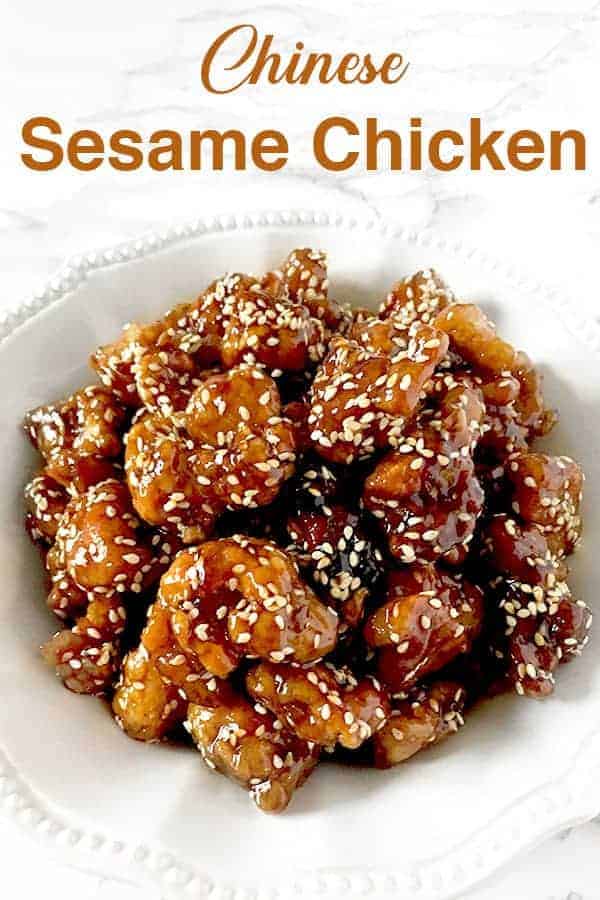
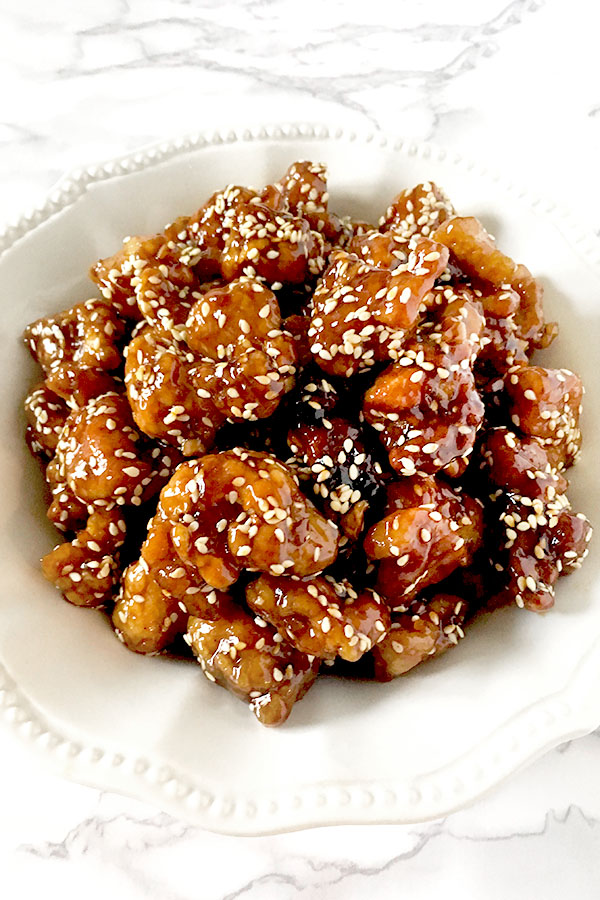
This kosher recipe for sesame chicken gives you a crunchy chicken coated in its classic sweet sauce.
It is easy to make at home and tastes just like sesame chicken in Chinese restaurants.
Serve with rice and steamed broccoli.
If there is one thing my family misses since moving to Israel, it's Chinese food.
Sure, there are Asian restaurants in Israel, but they do it differently.
Even if they had authentic Chinese food, it wouldn't be the same because what we miss is American-Chinese food.
What they long for are dishes that are completely unfamiliar to a native Chinese pallet.
I'm talking about sesame chicken, orange chicken, General Tso's chicken, and let's not forget my favorite, beef and broccoli.
This inspired me to see if I can make these recipes and more on my own.
I started with lemon chicken, a dish popular in Canadian Chinese takeout, because I had a bunch of lemon sitting around.
Once I saw how easy it was to make that, I figured it would be just as easy to make most things and I wasn't wrong.
This recipe couldn't be easier.
At first glance, it looks like a laundry list of ingredients, but really most of them repeat and you can easily find all of them in your pantry or kitchen cupboards.
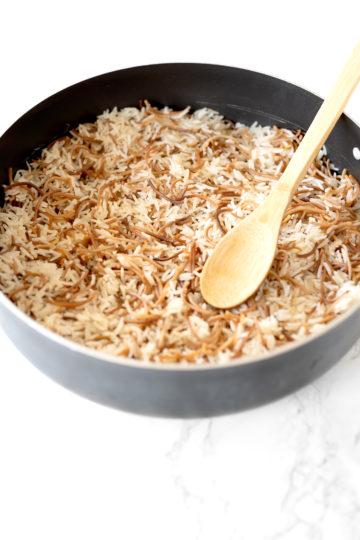
Serve with white rice or fried rice.
Why does this recipe suggest dry sherry?
Some sesame chicken recipes call for shaoxing wine.
Shaoxing wine is not only hard to find depending on where you are from (and I don't like requiring specialty items in my recipes), but is also exceedingly hard - if possible at all - to find kosher.
So, since dry sherry is easier to find and can be found kosher, I list it as an option.
However, I personally don't think this ingredient changes the recipe enough to make it a requirement.
You can easily make this recipe without dry sherry. I usually leave it out.
Why is sesame oil optional?
Sesame oil is relatively expensive and adds more calories to an already fattening dish. Most recipes require it and if you have it on hand, you are welcome to use it.
Personally though, I don't think it makes enough of a difference to the flavor to require it, and when making this dish, I usually leave it out.
DARK MEAT VS WHITE MEAT
Most people have a preference between eating white meat or dark meat. They both certainly have their benefits and detriments in this recipe.
White meat has the benefit of being lean, more readily available as boneless and skinless, and it cooks quickly.
Dark meat is juicier and does not dry out as quickly, making it a safer choice.
At the end of the day, you can use either white or dark meat for this recipe. The choice is yours. I often just choose based on what I have on hand.
GLUTEN FREE OPTION
For a gluten free alternative, use corn starch or potato starch instead of flour. They both fry very nicely.
HOW TO DREDGE CHICKEN
Double Handed
Use one hand to dip the chicken in the egg and the other to roll it in flour. By using both hands, you avoid getting thick layers of batter on your fingers known as "club hand."
Container Technique
Place half the flour at the bottom of a container. Add the chicken and cover with the remaining flour. Cover with a lid and shake for a few minutes. Each piece should come out well coated.
A WORD ON OIL
When frying chicken, the temperature of the oil is important.
If it's too cold, the chicken will be oily. On the other hand, if the oil is too hot, the crust will fall off. With a thermometer, it should about 350°F or 175°C to 375°F or 190°C degrees.
If you don't have a thermometer, when the oil seems hot, drop a little flour into the oil. If the flour sizzles and floats on the top, it's hot enough.
To make sure it's not too hot, keep it around medium-low and adjust as needed.
IS KOSHER CHICKEN BETTER?
Kosher animals are kept in better conditions than non-kosher animals due to strict kosher health requirements of the animals.
Also, the salting process used as part of the process of making meat kosher is similar to dry brining, and therefore produces a better quality meat.
While I've only eaten kosher meat so I cannot compare, I've been told by non-Jews who do not keep kosher that they've noticed that kosher chicken is of superior quality to cook with.
SHOULD YOU WASH CHICKEN?
According to the USDA, you should not wash meat or poultry, since water can splash bacteria up to 3 feet surrounding your sink.
A study done by Drexel University shows that it is best to move meat and poultry directly from package to pan. The heat from cooking will get rid of any bacteria that may be present.
HOW CAN I CLEAN MY CHICKEN WITHOUT WASHING IT?
If you want to clean your chicken without washing it, wipe it down with a wet paper towel.
Just make sure the paper towel doesn't touch anything else and to toss the paper towel right away.
HOW TO DEFROST CHICKEN
IN THE FRIDGE
Defrosting chicken in the fridge is the most highly recommended.
To do this, place the frozen chicken in a pan and let it thaw. Oftentimes, when chicken thaws, it releases liquids that can leak onto your fridge, so the pan is really helpful.
Chicken typically takes a full day to thaw. Once thawed, it can remain in the refrigerator for a day or two before cooking.
IN COLD WATER
Defrosting chicken in water should take two to three hours.
Submerge your sealed chicken in a pot or bowl full of cold water. Change out the water every 30 minutes or so.
Do not hot use water because it can start cooking your chicken.
Can you cook FROZEN chicken?
According to the USDA, you can cook frozen chicken. It will take 50% longer to cook, but it's an option.
You should also cook it on a roasting rack or over vegetables so that the heat can circulate around the chicken.
CAN YOU REFREEZE RAW CHICKEN?
According to the USDA, "food thawed in the refrigerator is safe to refreeze without cooking." However, you do lose quality when refreezing previously defrosted meat.
Every time you defrost meat, it loses moisture as it thaws, which also leads to a loss in flavor. To compensate for this, marinate the chicken to add more flavor and juice.
The USDA also says not to "refreeze any foods left outside the refrigerator longer than 2 hours; 1 hour in temperatures above 90°F."
SHOULD YOU BRINE?
Brining actually doesn't do anything to help poultry. In fact, it makes it soggy rather than juicy, with watered-down flavor.
Aromatic brines and stock don't help with flavor either. This is because the salt pulls water molecules in, leaving most of the flavor behind.
DRY BRINING
A dry brine, on the other hand, loosens up muscle fibers, allowing them to retain more moisture without adding any excess liquid.
Initially, the salt draws moisture out, then it dissolves in this liquid, creating a concentrated brine, which eventually gets reabsorbed. This leads to more intensely flavored results.
An added benefit is that it also requires less space and mess than a water brine. Not to mention the fact that it allows for crispier skin.
CAN YOU DRY BRINE KOSHER chicken?
Food experts are often under the impression that kosher meat and poultry cannot be brined and dry brined.
This is because of the koshering process, which involves salting the meat. However, the process is not nearly as long as the dry brining process, and unlike a dry brine, the poultry is soaked to remove the salt.
So, since the process is different than a dry brine, it is fine and even recommended to dry brine kosher poultry and meat.
How do you dry brine chicken?
Begin by patting the chicken with paper towels. This will help the salt adhere to the chicken.
Grab pinches of kosher salt and sprinkle it over the chicken until the chicken is generously salted and evenly coated.
Place the dry-brined chicken on a rack or a plate and refrigerate it. Refrigerate chicken pieces for at least 1 hour, skinless pieces for 30 minutes to 1 hour or up to about 12 hours, and a whole chicken for 8-24 hours.
Once the waiting period is up, there is no need to rinse off the chicken. Just cook it as usual.
DO EGGS NEED TO BE AT ROOM TEMPERATURE?
The short answer is "no." That rule is for baking, and even then, a side-by-side comparison shows that baking with eggs at room temperature makes a better crumb, it's not otherwise noticeable, and when dividing eggs for baking they should be cold because it helps separate the yolk and whites better.
What are Eggs used for?
Eggs do three things in most recipes: they help bind the ingredients together, act as a mild leavening agent, and they add moisture.
For example, eggs are the primary binder in a pumpkin pie, creating a sliceable custard. In my chewy brownies on the other hand, they primarily act as a leavener.
In this recipe the are mostly used for binding the breading and to lock in moisture.
ARE EGGS DAIRY?
No, eggs are not dairy. Dairy is milk and any food products made from milk, including cheese, cream, butter, and yogurt.
So, while eggs are an animal product, they are not dairy. For instance, scrambled eggs made without milk, are in fact dairy free.
How to tell if your eggs are still good
Fill a glass with cool water and submerge the eggs.
If the eggs sink to the bottom and lay flat on their side, they're still fresh.
If they sink, but stand on one end at the bottom of the glass, the eggs are not as fresh but still good.
An egg that floats to the top is likely spoiled.
Sugar
The primary role of sugar is to be a sweetener. However, sugar also contributes to the tenderness and moistness of the baked good by absorbing and retaining moisture and helps create the golden brown color when baking as it caramelizes.
Recipes with more sugar often result in softer, moister textures. However, I learned the hard way that too much sugar leads to a sticky mess.
When it's heated, sugar caramelizes, resulting in a rich, complex flavor and a brown color. This adds both flavor and color to baked goods and is also the process in which caramel sauce, dulce de leche, caramel candies, and regular candies are made.
When used in recipes containing yeast, the sugar is eaten by the yeast, producing carbon dioxide and causing the dough to rise.
Sugar also acts as a preservative in jams, jellies, and fruit preserves by reducing water activity and preventing microbial growth.
There are many different types of sugar, including white sugar, brown sugar, vanilla sugar, powdered sugar, turbinado sugar, and demerara sugar.
When a recipe calls for "sugar" without specifying anything else, it's referring to regular white sugar.
White Sugar
White sugar (sometimes called granulated sugar, table sugar, or white granulated sugar) is made of either beet sugar or cane sugar, which has undergone a refining process.
It is the easiest to find and most commonly used.
Brown Sugar
Brown sugar is white sugar with molasses added to it.
It is commonly used in chocolate chip cookie recipes, and it's rare for a recipe that calls for brown sugar not to also call for white sugar as well.
When a recipe calls for "brown sugar" but doesn't specify what type (light or dark), it is referring to light brown sugar.
In my recipes, you can use whatever type of brown sugar you have on hand, whether it is dark brown sugar, light brown sugar, or demerara sugar - which is very common in Israel.
Just keep in mind that the flavor and color will be slightly different, depending on what you choose to use.
Turbinado Sugar
Turbinado sugar is better known as "raw sugar." But, despite this name, the sugar is not really "raw."
Instead, it's partially refined sugar that retains some of the original molasses.
The term "raw sugar" may also give off the impression that it is somehow healthier.
In reality, turbinado sugar is nutritionally similar to white sugar.
Demerara Sugar
Demerara sugar is very popular in Israel and is especially delicious in tea, but is also used for baking.
Unlike white sugar, demerara sugar undergoes minimal processing and retains some vitamins and minerals.
However, it is still not much healthier than white sugar.
Vanilla Sugar
Vanilla sugar is not very common in the States. However, it is common in Israel and parts of Europe.
This is sugar that sat for an extended period of time with vanilla beans, giving it a vanilla flavor.
Caster Sugar
This type of sugar is common in the United Kingdom.
It has a grain finer than white (granulated) sugar and larger than powdered sugar.
Caster sugar is often called for in recipes for delicate baked goods like meringues, souffles, and sponge cakes.
You can use a 1:1 conversion rate between caster sugar and white (granulated) sugar.
Powdered sugar
Powdered sugar, sometimes known as confectioners' sugar, is a sugar with a powdered texture.
This sugar is rarely used for baking. Instead, it is used for dusting desserts and making frosting, icing, and glazes.
In some countries, you can also find powdered vanilla sugar.
It is made the exact same way regular vanilla sugar is made. However, the sugar used is powdered instead of granulated.
Vanilla Extract vs Vanilla sugar
In my recipes, I don't specify what kind of vanilla to use.
The reason for this is that in the States, vanilla extract is exclusively used.
Meanwhile in Israel, along with many European countries, vanilla sugar is common.
In most, if not all recipes, both vanilla extract and vanilla sugar can be used.
In recipes where vanilla sugar can be used instead of extract, you can replace them 1:1.
Replacing Sugar with Honey
If you'd prefer to use honey instead of sugar, like I do in my honey challah recipe, you can do so with pretty good results.
Honey can be two or even three times as sweet depending on the honey, so for every 1 cup of sugar, you can use ½ to ⅔ cup honey.
Since honey adds liquid, you need to remove some to balance it out. For every cup of honey, remove a ¼ cup of liquid.
Also, it burns faster than granulated sugar, so you want to lower the baking temperature by 25°F. In addition, check it early and often to avoid burning or over-baking.
BROWN SUGAR
What we call brown sugar is essentially white sugar that has had molasses added back to it.
It should not be confused with raw sugar or demerara, which are their own types of sugar.
You can easily substitute brown sugar or even make brown sugar.
Both dark and light brown sugar can easily be made at home if you have a little white sugar and molasses.
It is commonly used in chocolate chip cookie recipes, and it's rare for a recipe that calls for brown sugar not to also call for white sugar as well.
When a recipe calls for "brown sugar" but doesn't specify what type (light or dark), it is referring to light brown sugar.
DARK BROWN SUGAR
Dark brown sugar can be made with 1 cup white granulated sugar and 2 tablespoons molasses.
Add both ingredients into a bowl and mix with a fork until completely mixed.
LIGHT BROWN SUGAR
Light brown sugar can be made with 1 cup white granulated sugar and 1 tablespoon molasses.
Add both ingredients into a bowl and mix with a fork until completely mixed.
DEMERARA
Demerara is popular in Israel and is easier to find than light brown sugar. It is a type of cane sugar with a nice toffee flavor and can be used in place of brown sugar.
HOW TO SUBSTITUTE DARK AND LIGHT BROWN SUGAR
DARK BROWN SUGAR
Dark Brown Sugar can be made with 1 cup of light brown sugar and 1 tablespoon molasses.
Add both ingredients into a bowl and mix with a fork until completely mixed.
LIGHT BROWN SUGAR
Light Brown sugar can easily be replaced in a recipe with half dark brown sugar and half white granulated sugar.
DOES THE TYPE OF BROWN SUGAR YOU USE REALLY MATTER?
Using the wrong brown sugar will change the flavor and likely the color.
Dark brown sugar has more molasses, which will give it a deeper, more complex flavor that's closer to toffee or caramel.
Light brown sugar is more subtle, which is sometimes ideal.
However, I tend to use what's on hand, which for me means dark brown sugar in Israel and light brown in the States.
I also happen to love the extra flavor dark brown sugar gives, so I like using it even if I have both on hand.
How to Store Brown Sugar
Store brown sugar in an airtight container to maintain its moisture and prevent it from hardening.
Why Use Cornstarch
Starch is a natural component of almost all grains and some fruits and vegetables.
One of starch's compelling properties is its ability to absorb and retain lots of liquid.
Starches are incredibly versatile ingredients. They cause the liquid to thicken and add moisture as well as a tender and delicate texture in baked goods.
They can also be combined with water as an egg replacement for eggless and vegan recipes, working as a binder and to add moisture.
In addition, starches are sometimes used to make a coating for frying, which creates a crispy texture on fried foods like fried chicken.
It's also not uncommon to find starch used as a stabilizer.
Cornstarch is one of the most versatile starches there are. It is a terrific ingredient for thickening sauces, puddings, soups, and pie fillings and is also used in many baked good recipes.
Cornstarch Uses
Cornstarch is an underrated and underused ingredient in home kitchens. Here are a number of ways cornstarch can be used:
Cornstarch for thickening soups, stews, and gravies
Cornstarch is often used as a thickening agent when added to soups, stews, and gravies.
This is usually done by making a slurry which is then added to whatever is in need of thickening.
Cornstarch in baked goods
Starch helps keep breads, cakes, quick breads, muffins, cupcakes, and brownies fresh by absorbing and holding liquid.
For breads, you can replace up to ¼ cup of all-purpose flour with cornstarch out of every three cups of flour.
For cakes, quick breads, muffins, and cupcakes, you can replace 2 tablespoons out of every cup of all-purpose flour.
Cornstarch in Cookies
Cornstarch gives cookies a soft center, helps prevent them from spreading, and adds chewiness.
Add ½ to 1 teaspoon of cornstarch per cup of flour called for in the recipe.
Cornstarch for Chewy Brownies
For chewy brownies that taste like those from the box, add 1 tablespoon of cornstarch per ½ cup of flour.
How to substitute Cornstarch
Cornstarch is one of a number of starches available - though it tends to be the easiest to find.
The best alternative to cornstarch in my opinion is potato starch.
You should substitute potato starch for cornstarch in a 1:1 ratio. This means if you need 1 tablespoon of cornstarch, use 1 tablespoon of potato starch instead.
How to Store Sugar
Sugar should be stored in an airtight container to prevent clumping and moisture absorption, and kept in a cool, dry place.
HOW TO STORE CHICKEN
Place cooled chicken in an airtight container or wrap in heavy-duty aluminum foil or plastic wrap. Store in the fridge for up to 4 days.
HOW TO FREEZE CHICKEN
Freeze leftovers within 3-4 days. Place cooled chicken in an airtight container or resealable freezer bag.
Freeze for up to 4-6 months. After that, it is still safe to eat, but the quality begins to degrade.
Other recipes you may like:
Kosher Sesame Chicken
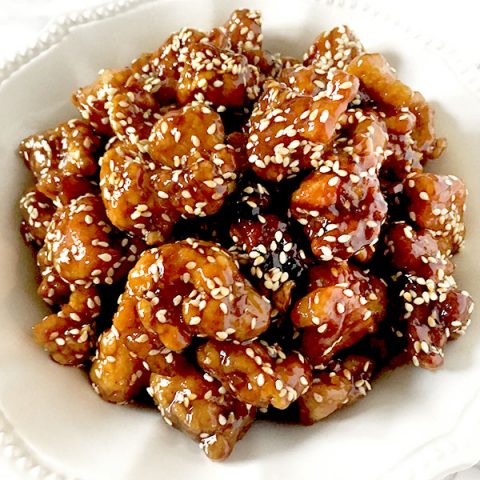
This easy recipe for Chinese sesame chicken gives you a crunchy chicken coated in its classic sweet sauce.
Ingredients
Batter
- 1 egg
- 3 tablespoons cornstarch
- 2 tablespoons soy sauce
- 1 pound chicken, boneless and skinless (455 grams), cut into ½ to ¾-inch chunks (1.3 to 2 centimeters))
Dry Coating
- ½ cup cornstarch (65 grams)
- ½ cup all-purpose flour (65 grams)
- ½ teaspoon baking powder
- ½ teaspoon kosher salt
Sauce
- 1 teaspoon peanut or neutral flavored oil
- 2 medium cloves garlic, minced
- ½-inch piece ginger, minced
- 3 tablespoons soy sauce
- 2 tablespoons dry sherry, optional
- 2 tablespoons brown sugar
- 2 tablespoons white sugar
- 1 tablespoon cornstarch
- 1 tablespoon distilled white vinegar
- 2 teaspoons roasted sesame seed oil
- 1 teaspoon chicken bouillon powder
- 2 tablespoons toasted sesame seeds
Instructions
- Whisk to combine egg, cornstarch, and soy sauce in a mixing bowl. Once you have a smooth batter, add the chicken and let sit for half an hour.
- In a second mixing bowl, add cornstarch, flour, baking soda, and salt. Whisk to combine.
- Heat oil in preferably a heavy bottom frying pan or a wok. You know the oil is hot enough when you drop in a bit of batter and it sizzles. You want a temperature between 325°F and 375°F or 160°C and 190°C.
- Roll each piece of battered chicken in the dry mixture. Shake off excess and add it to the hot oil. Repeat until the pan is full but not overcrowded. Fry until crispy and place on a paper towel lined plate. Repeat in batches with the remaining pieces of chicken.
- In a frying pan, add oil. When it begins to simmer, add garlic and ginger. Lightly fry for about 10 seconds, constantly stirring.
- Add soy sauce, sherry if desired, brown sugar, white sugar, cornstarch, vinegar, sesame oil, and bouillon powder. Stir until everything is well combined, including the sugar. Simmer until it develops a thick syrup-like texture. Let cool slightly.
- Place the chicken in the sauce, sprinkle sesame seeds, and toss to coat.
Nutrition Information:
Yield:
4Serving Size:
1Amount Per Serving: Calories: 583Total Fat: 26gSaturated Fat: 5gTrans Fat: 0gUnsaturated Fat: 19gCholesterol: 154mgSodium: 1574mgCarbohydrates: 53gFiber: 1gSugar: 12gProtein: 32g
A genuinely excellent article which explains everything a home cook needs to know.
I'm glad you found it helpful 🙂
sound very good,i'll try it for sure
I look forward to hearing how you enjoy it 🙂